Amazon Advertising
10 questions to ask an Amazon agency before you hire one
Here are ten real questions to ask an Amazon agency before you hire one, pulled from a summer of RFPs and prospect calls at Incrementum. Liran Hirschkorn, our founder, posted all ten on LinkedIn and left the answers out on purpose. A list of questions with no explanation of why they matter doesn’t help anyone use them on an actual call.
Learn How to Make Listings That Convert in 2025!
Read our step-by-step guide on how to optimize your listings using Rufus AI insights. Sign up for our newsletter and get your copy for free!
Show me howThis post supplies that explanation. For each question, you get what it’s testing and the mechanic behind it, not a script for what a “good” answer sounds like. A rehearsed answer is exactly what these questions are built to catch. What can’t be rehearsed is having an actual operating model behind the answer.
If you’re still deciding how to structure the whole evaluation process, How to Choose the Right Amazon Agency (Without Wasting 12 Months) covers that ground. This post picks up after that decision is made, with the specific questions worth bringing to the call.
What makes a good Amazon agency evaluation question?
A good Amazon agency evaluation question asks for a mechanism or a commitment instead of a capability. Capability questions ask whether a service exists on a rate card. Mechanism questions ask how the agency would actually behave in a specific, constrained situation, and those can’t be improvised in a pitch meeting.
Anyone can say yes to “do you do DSP?” That answer costs nothing and reveals nothing about how the account would actually be run. The ten questions below are built the other way: each one forces a specific process, timeline, or commitment into the open.
| Question type | What it sounds like | What it actually reveals |
|---|---|---|
| Capability | “Do you run Sponsored Display and DSP?” | Whether a service line exists. Says nothing about how well or how often it’s actually used. |
| Credential | “How many brands do you manage as an Amazon Ads Advanced Partner?” | Scale and platform standing. Useful context, but doesn’t predict how your specific account gets handled. |
| Mechanism or commitment | “How do you separate correlation from causation in your results?” | Whether a real, repeatable process sits behind the reporting, or whether good numbers just get credited to whatever was running at the time. |
The 10 questions to ask an Amazon agency
- How do you separate correlation from causation in your results?
- How do you know an ad sale is incremental, especially on branded keywords?
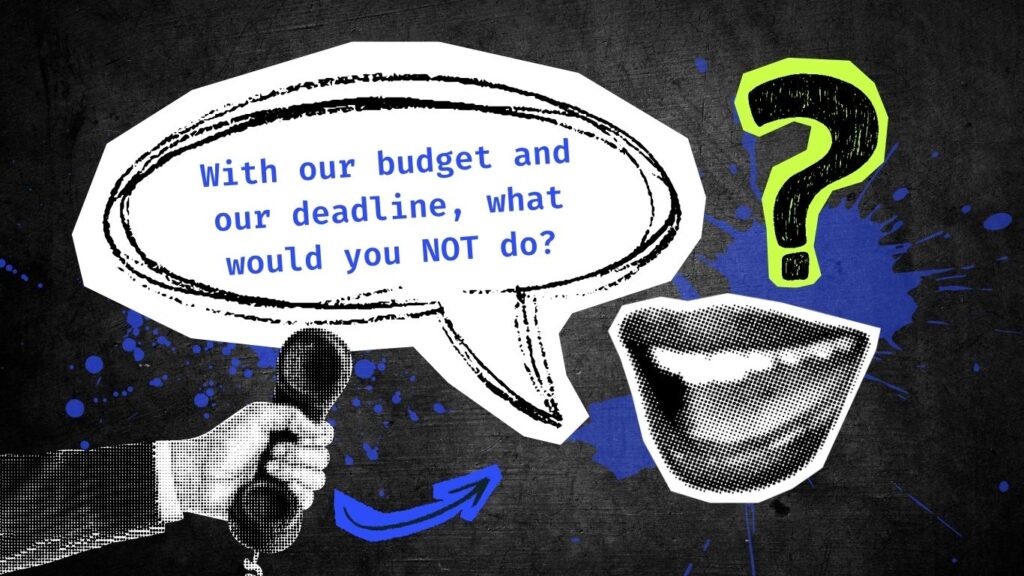
- With our budget and our deadline, what would you NOT do?
- Name a decision your data changed last quarter.
- Walk me through the day we lose the Buy Box or a listing gets taken down.
- We have a tentpole event in five weeks. How does your transition plan interact with it?
- Will we see every change you make in the account?
- Is the team that onboards us the team that manages us?
- What happens when you miss the goal?
- Can we start phased, and how do we exit?
1. How do you separate correlation from causation in your results?
This question tests whether an agency can tell the difference between something they did and something that would have happened anyway. Amazon accounts move for reasons that have nothing to do with the ad account: seasonality, a competitor’s stockout, a price change, a review milestone, organic momentum that was already building before the campaign launched.
Real separation needs either a controlled comparison, such as a holdout audience, a phased rollout, or a geographic split, or at minimum a baseline documented before the change went live, not reconstructed after a good number needs an explanation. The weak version of this answer credits a metric’s movement to whatever campaign happened to be running in that window, without naming anything else in the account or the market that changed at the same time.
2. How do you know an ad sale is incremental, especially on branded keywords?
This is the hardest question on the list to answer honestly, and the one with the most room for an agency to talk past it. Branded search is the clearest example: a shopper who already knows your brand name and searches for it was likely coming to buy from you regardless of whether an ad appeared. Amazon’s own reporting still counts that purchase as an attributed ad sale, because attribution measures whether an ad was present in the path, not whether the ad caused the purchase.
Proving incrementality on branded terms requires isolating what happens without the ad running: a branded-term pause test over a defined window, a holdout audience that never sees the ad, or a geographic or time-based experiment that compares matched conditions with and without spend. Citing a low ACoS on the branded campaign doesn’t answer the question. ACoS measures spend efficiency against attributed sales; it says nothing about whether those sales were caused by the ad or would have closed anyway.
The underlying issue is a reporting model problem more than a keyword problem. Amazon’s standard attribution gives outsized credit to whichever touchpoint happens last, and a branded search is almost always the last click no matter what earlier ad or organic touchpoint actually did the persuading. Last-touch attribution has this same blind spot across the account, not just on branded terms, which is why an agency’s answer here should extend past branded keywords into how they read attributed sales generally.
Related reading: the Search Query Performance report is one of the few native Amazon data sources that shows whether a branded click came from a shopper who searched a generic term first, which is a useful starting point for this conversation even though it doesn’t settle incrementality on its own.
3. With our budget and our deadline, what would you NOT do?
This question tests prioritization under a real constraint, not an inventory of everything an agency would do with an unlimited budget. Every account has more good ideas available than budget to fund them, and the answer that matters is which lever gets cut first and why that lever is the least load-bearing one for this specific goal.
A real answer names something concrete: DSP prospecting during a launch phase where the catalog can’t yet support the traffic, a competitor-conquesting campaign when defending existing branded share matters more given the deadline, or a broad-match expansion when the account’s margin structure can’t absorb the learning-phase inefficiency. Structural tradeoffs like these are exactly what determines whether an account’s margin survives a scaling push or gets eaten by it. An agency that answers with “we’d find a way to do it all” hasn’t actually made a decision.
4. Name a decision your data changed last quarter.
This question tests whether the account team looks at data to change plans, or whether the reporting just documents decisions that were already made. It’s phrased in the past tense on purpose. A philosophy about being “data-driven” is not an answer. A specific decision is.
A real answer names the decision itself, the number that triggered it, and roughly when it happened: a budget shift out of a category that stopped converting, a campaign paused because impression share collapsed at a profitable bid, a bid structure rebuilt after a search-term report showed spend concentrated on the wrong five keywords. If an agency can’t produce one specific example on the spot, that’s informative on its own.
5. Walk me through the day we lose the Buy Box or a listing gets taken down.
This question tests incident response. Losing the Buy Box or having a listing suppressed is one of the more common ways an account bleeds ad spend without anyone noticing immediately, because campaigns keep bidding on a listing that customers can no longer buy from.
A real process names who gets alerted, how quickly, and what happens to ad spend in the meantime: pausing or reallocating budget away from the affected listing while the underlying issue gets resolved, rather than continuing to bid on a listing that’s temporarily unbuyable. The weak version of this answer waits for the brand to notice the sales drop and escalate it, at which point the wasted spend has already happened.
6. We have a tentpole event in five weeks. How does your transition plan interact with it?
This question tests whether onboarding is planned around the brand’s calendar or the agency’s own convenience. Five weeks is enough time to get an account transition wrong if access, historical data, and campaign structure changes all land in the same window as the brand’s biggest event of the quarter.
A real transition plan sequences the work backward from the event: access and historical data fully migrated well ahead of it, structural changes completed and stable before a freeze period begins, and no experimental changes introduced once the event is close enough that a bad result can’t be unwound in time. An agency that treats the transition timeline as independent of the brand’s calendar hasn’t actually planned around the constraint the question describes.
7. Will we see every change you make in the account?
This question tests the transparency of the actual change log, not just the summary reporting. A quarterly business review can present a curated story about what happened. It doesn’t necessarily show every bid change, every negative keyword added, or every campaign paused in between.
A real answer points to a specific mechanism: shared change history inside the ad console, a live dashboard the brand can access anytime, or documented notes updated on a set cadence, independent of whatever gets highlighted in a scheduled call. This is the same kind of visibility an outside audit typically surfaces after the fact, on wasted spend, structural gaps, and changes nobody remembered making. A brand shouldn’t have to commission an audit to get that view of their own account on an ongoing basis.
8. Is the team that onboards us the team that manages us?
This question tests whether the senior team in the sales pitch actually touches the account after the contract is signed, or whether day-to-day management hands off to a different, more junior team once the deal closes.
A real answer names the actual person who will manage the account day to day, along with their tenure and what else is on their plate, before the contract is signed rather than after. An agency that answers with the title of whoever ran the pitch, without naming who actually does the work, is describing the sales process rather than the service.
9. What happens when you miss the goal?
This question tests whether there’s a defined process for underperformance, or just reassurance that the team will “keep optimizing.” Every account underperforms a goal at some point. What happens next is the part worth knowing before it happens to you.
A real answer names a specific trigger, a defined threshold missed over a defined timeframe, and a defined next step: a strategy review, a scope conversation about what’s realistic given the account’s constraints, or an honest option to part ways. An open-ended answer that promises continued effort without naming a trigger or a next step isn’t a process. It’s a hope.
10. Can we start phased, and how do we exit?
This question tests whether an agency is comfortable with a lower-commitment starting point and a clean exit, or whether the contract is structured to make leaving expensive or slow regardless of how the work performs.
A real answer specifies contract length, notice period, and exactly what happens to account access, campaign structure, and historical data on the way out. An agency confident in its own work generally has no reason to make the exit difficult. A long lock-in with a vague or absent exit process is itself an answer to the question.
What these questions won’t tell you
These ten questions test process and rigor. They don’t test fit: whether the day-to-day account manager communicates in a way that works for your team, whether the agency’s category experience actually matches your product, or whether the price makes sense for the scope of work. A team can answer every one of these questions well and still be the wrong match for reasons that have nothing to do with mechanism.
They also don’t replace looking at an actual account. A strong answer on paper describes how an agency operates in general. It doesn’t tell you what’s specifically wrong with your account right now, or whether the fixes an agency would prioritize match the fixes your account actually needs. If you’re still weighing whether to bring in an agency at all versus keeping this in-house, the real math on agency versus DIY is worth working through before the vetting call.
How to score the answers you get
This isn’t a graded key, and there’s no version of it where a specific score means “hire them.” It’s a way to notice the pattern in how a team answers, across all ten questions in the same call.
For each question, note whether the answer named something specific: a mechanism, a number, a timeframe, a named person, a defined trigger. Or whether it stayed general: a philosophy, a value statement, a promise to figure it out. A team that answers eight or more of the ten with something specific is describing an actual operating model. A team that goes general on more than half of them is describing how it would like to be perceived, not how it actually operates.
The pattern matters more than any single answer. One vague answer might just mean the question caught someone off guard. A pattern of vague answers across most of the list means the specificity isn’t there to give.
What to do next
If you’re bringing these questions into a real evaluation call, the goal isn’t to catch an agency out. It’s to find out, before signing anything, whether there’s an actual operating model behind the pitch. If you’d rather have Incrementum walk you through what a real account review finds first, a free Amazon audit is a low-commitment way to see the mechanism in practice before you evaluate anyone against these ten questions, including us.
Incrementum Digital is a full-service Amazon agency managing advertising, operations, and growth strategy for brands from seven to nine figures in annual revenue, and a certified TikTok Shop management partner. incrementumdigital.com





LET’S DISCOVER WHAT’S POSSIBLE FOR YOUR BRAND
We’re here to listen and uncover opportunities tailored to your unique goals.
Fill out the form to get started, and you’ll walk away with real insights and actionable recommendations—whether we work together or not.
- HANDS-ON LEADERSHIP
- AWARD-WINNING PARTNERSHIPS
- CUSTOM-BUILT SOLUTIONS