Amazon Advertising
What does an Amazon PPC audit find? Here are 3 real brand examples with actual data.

Any brand knows their Amazon advertising could always be performing better. But the hard part is knowing where to look… and knowing whether the agency or team managing your campaigns has actually looked. As a PPC audit agency, we’ve reviewed hundreds of Amazon ad accounts across categories ranging from food and CPG to outdoor gear to toys. And while every account is different, the patterns that show up are remarkably consistent. Campaign structures that quietly limit visibility. Budget leaking into keywords that stopped converting months ago. Sales being attributed to ads that may not have actually influenced the purchase. Entire ad formats sitting unused while competitors take advantage of them.
Learn How to Make Listings That Convert in 2025!
Read our step-by-step guide on how to optimize your listings using Rufus AI insights. Sign up for our newsletter and get your copy for free!
Show me howThe problem isn’t that these issues are hard to fix. It’s that most brands don’t know they exist until someone from outside the account takes a look.
Here are three real Amazon advertising audits we conducted recently. Anonymized, but otherwise exactly what we found. If any of this looks familiar, there’s a good chance the same dynamics are playing out in your account.
Audit 1: A food brand spending only on Sponsored Products — and leaving its best keywords starved
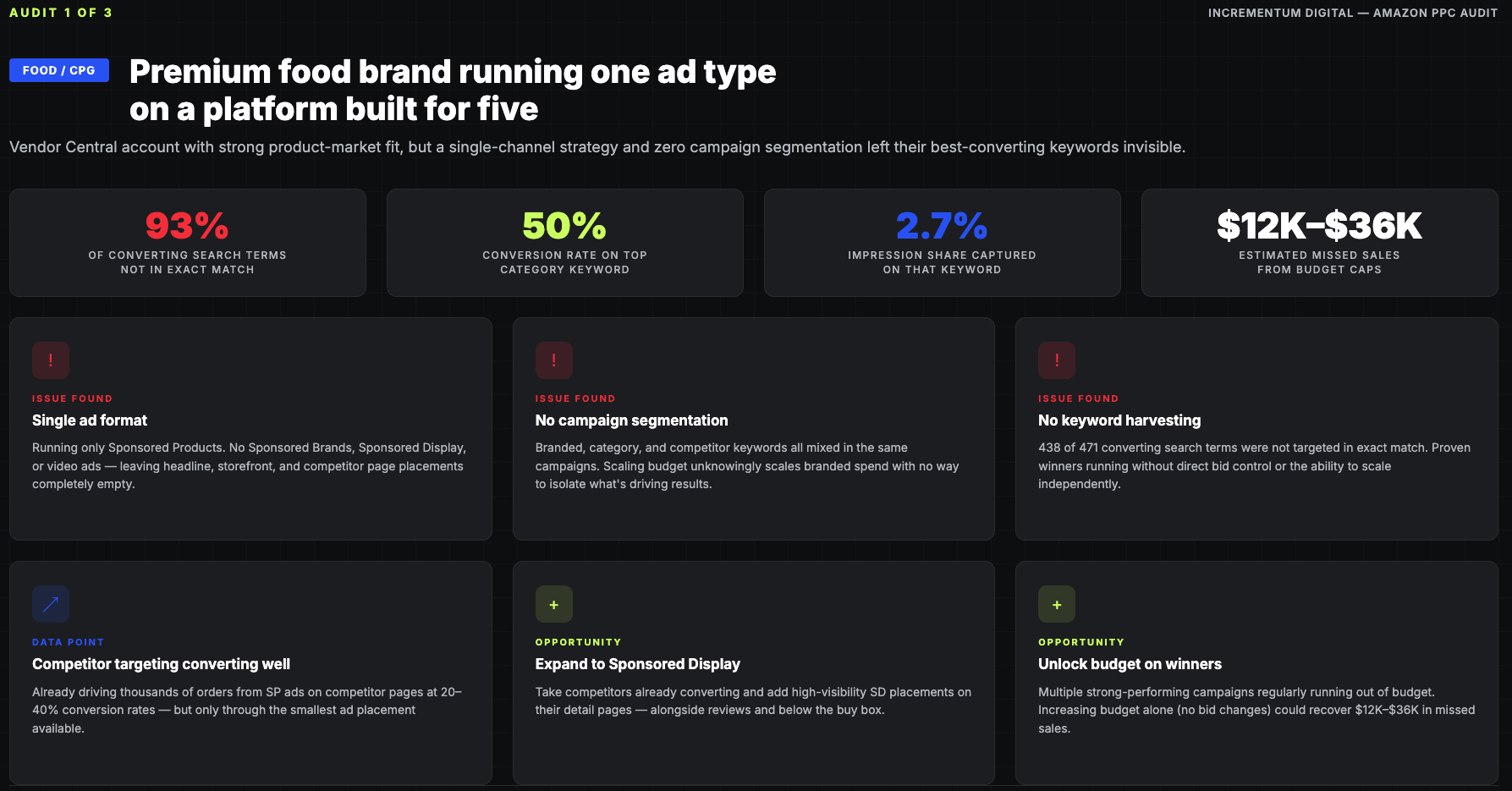
This brand sells a premium product in a competitive food category through Vendor Central. They had been steadily increasing their ad budgets, and sales were climbing. On the surface, things looked solid. ACOS ranged between 20% and 40%, and TACOS hovered between 10% and 19%.
But when we opened the account, the first thing that jumped out was that they were running exclusively Sponsored Products. No Sponsored Brands. No Sponsored Display. No video ads. For a brand with strong name recognition and excellent conversion rates, that’s a significant missed opportunity. Amazon’s own research shows that campaigns using multiple ad types together consistently outperform single-type campaigns — and advertisers using Sponsored Products alongside Sponsored Display saw a 22% increase in new-to-brand customers on average.
The second issue was campaign structure. Branded keywords, category keywords, and competitor keywords were all mixed into the same campaigns. That means when the team saw a campaign performing well and scaled the budget, they had no way to know whether that budget was going toward acquiring new customers or just bidding more on people already searching for the brand by name.
Then we looked at the search term impression share report, and that’s where it got interesting.
One of their top category keywords had a 50% conversion rate — nearly as high as their own branded terms — with a 14% ACOS. That’s exceptional for a non-branded keyword. But they were only capturing 2.7% of the available impressions for that term. Fourteen other brands were getting more visibility. The keyword was buried inside a broad campaign with dozens of other terms, and it was never being targeted in exact match where it could be scaled independently.
When we looked at keyword harvesting across the account, we found 471 search terms that had each driven at least three orders in the last 30 days. Of those, 438 were not being targeted in exact match. That’s over 90% of their proven, converting search terms operating without direct control.
We also found strong-performing campaigns that were regularly running out of budget. Amazon’s own estimates showed between $12,000 and $36,000 in missed sales from budget-constrained campaigns that were already converting well. These weren’t underperforming campaigns that needed more spend — they were proven winners being throttled.
On the competitor targeting side, the brand was already driving thousands of orders from Sponsored Product ads on competitor pages, with conversion rates between 20% and 40%. But all of that was through the small Sponsored Product placement. Sponsored Display ads — which appear on product detail pages alongside customer reviews — weren’t being used at all. That’s low-hanging fruit: take the competitors you’re already converting against and get bigger, more visible placements on their pages.
The total picture: a brand with genuinely strong product-market fit, hampered by a single-channel ad strategy, no campaign segmentation, and no systematic process for harvesting and scaling its best-performing keywords.
Audit 2: An outdoor brand whose “strong” results were partly an illusion
This brand sells seasonal outdoor accessories. They had been working with a well-known Amazon-focused agency and assumed things were being managed according to best practices. ACOS was in the 25–40% range, TACOS between 14% and 20%. Sales had been declining over recent months, and TACOS was trending upward. They wanted to understand why.
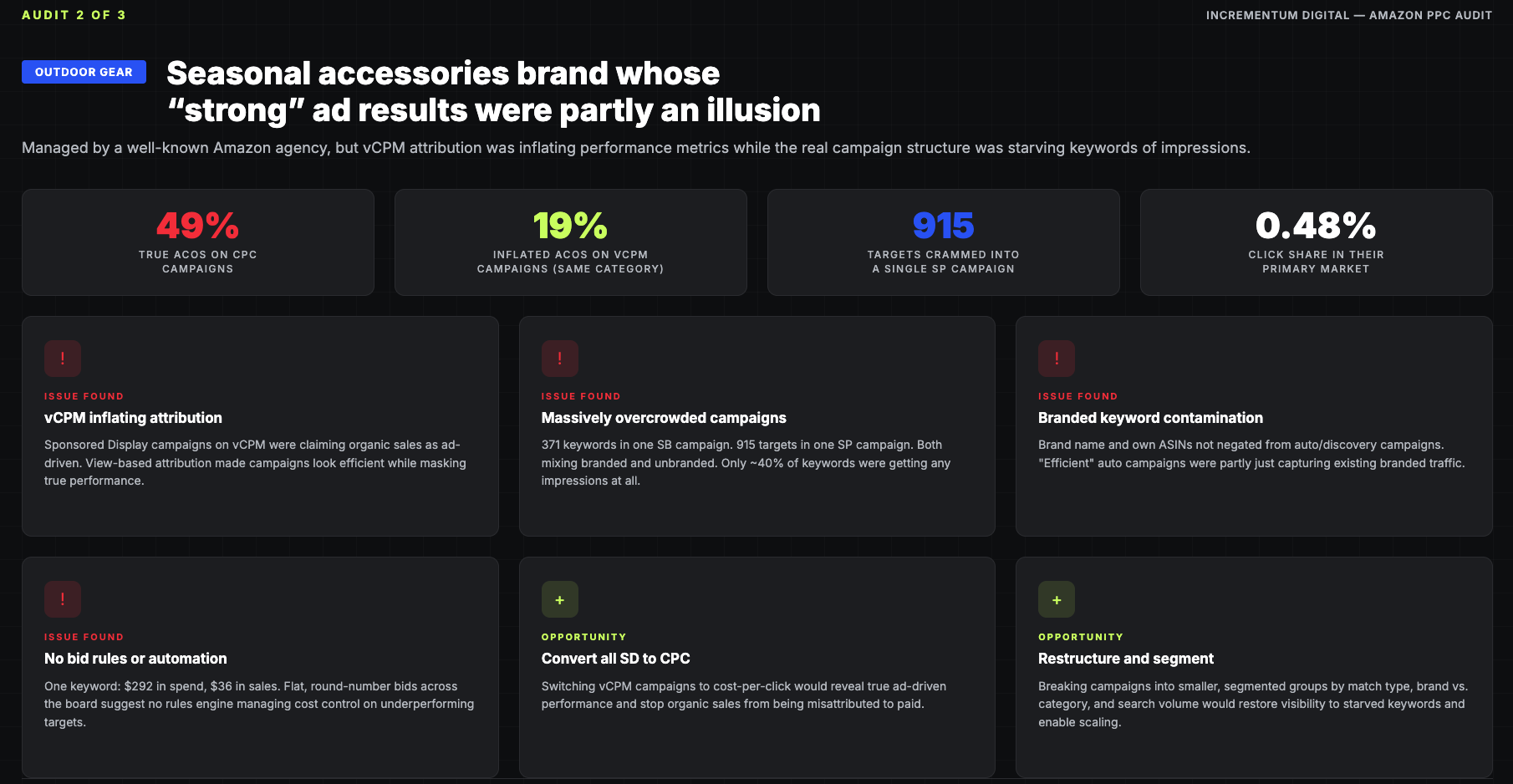
The first finding was unexpected: a significant portion of their Sponsored Display campaigns were running on a vCPM (cost-per-thousand-impressions) basis instead of CPC (cost-per-click). This is a critical distinction. In a vCPM campaign, Amazon attributes a sale to your ad if a shopper merely views the ad impression — they don’t have to click. That means someone could visit a competitor’s listing, see your ad in passing without clicking, then navigate to your product separately and purchase. That sale gets attributed to the ad.
The result was a set of campaigns that looked like they were performing extremely well. We could see the pattern clearly: CPC campaigns were showing 49% ACOS, while CPM campaigns in the same category showed 19% and 26% ACOS. The CPM numbers were artificially flattering the account’s overall metrics. Some of those “ad-driven” sales were almost certainly organic purchases that would have happened regardless.
This matters for more than just reporting accuracy. If you’re making budget decisions based on inflated attribution — scaling campaigns that look efficient because they’re claiming organic sales — you’re misallocating spend away from campaigns that are actually influencing purchase decisions.
The campaign structure issues were equally significant. One Sponsored Brand campaign contained 371 keywords. One Sponsored Products campaign had 915 targets. Both mixed branded and unbranded terms. When the team saw strong performance and increased budgets, there was no way to tell if that money was flowing toward new customer acquisition or just branded defense.
The branded keyword contamination extended to auto campaigns as well. The brand’s own name and ASINs weren’t negated from discovery campaigns, so auto campaigns that appeared to be efficiently finding new customers were partly just capturing branded traffic.
As a result of the overcrowded campaign structure, many keyword targets and competitor ASINs were getting zero clicks — not because they were poor targets, but because they were competing for visibility within campaigns that had too many targets sharing a single budget. Research from Seller Sprite found that in overcrowded Amazon campaigns, only about 40% of keywords actually receive impressions — the rest get nothing. Helium 10’s campaign structure guide recommends smaller, more focused keyword groups for exactly this reason.
On keyword harvesting, 78 of 140 converting search terms were not in exact match. And we found high-ACOS terms that clearly weren’t being managed — one keyword had accumulated $292 in spend against just $36 in sales, suggesting no bid rules or automation were in place to control runaway costs.
The owner’s reaction was telling. He was surprised — and disappointed — that the campaign structure was so far from standard best practices. As he put it, “you think you’re working with a top-tier group.” This is one of the most common reasons brands seek a PPC agency audit: not because they think everything is broken, but because they want an independent set of eyes to confirm whether their current management is actually doing what they’d expect them to be doing.
Audit 3: A toy brand dominating its niche but invisible in the bigger market
This brand sells licensed toys in a niche category. Their numbers looked healthy: ACOS between 17% and 27%, TACOS between 6% and 10% — well below the average ACOS of roughly 30% that Ad Badger reports across Amazon advertisers (with category-level benchmarks varying significantly by ad type and vertical). Sales were growing year over year, and they had strong brand recognition thanks to licensing deals and off-Amazon advertising driving branded search.
So what was the problem?
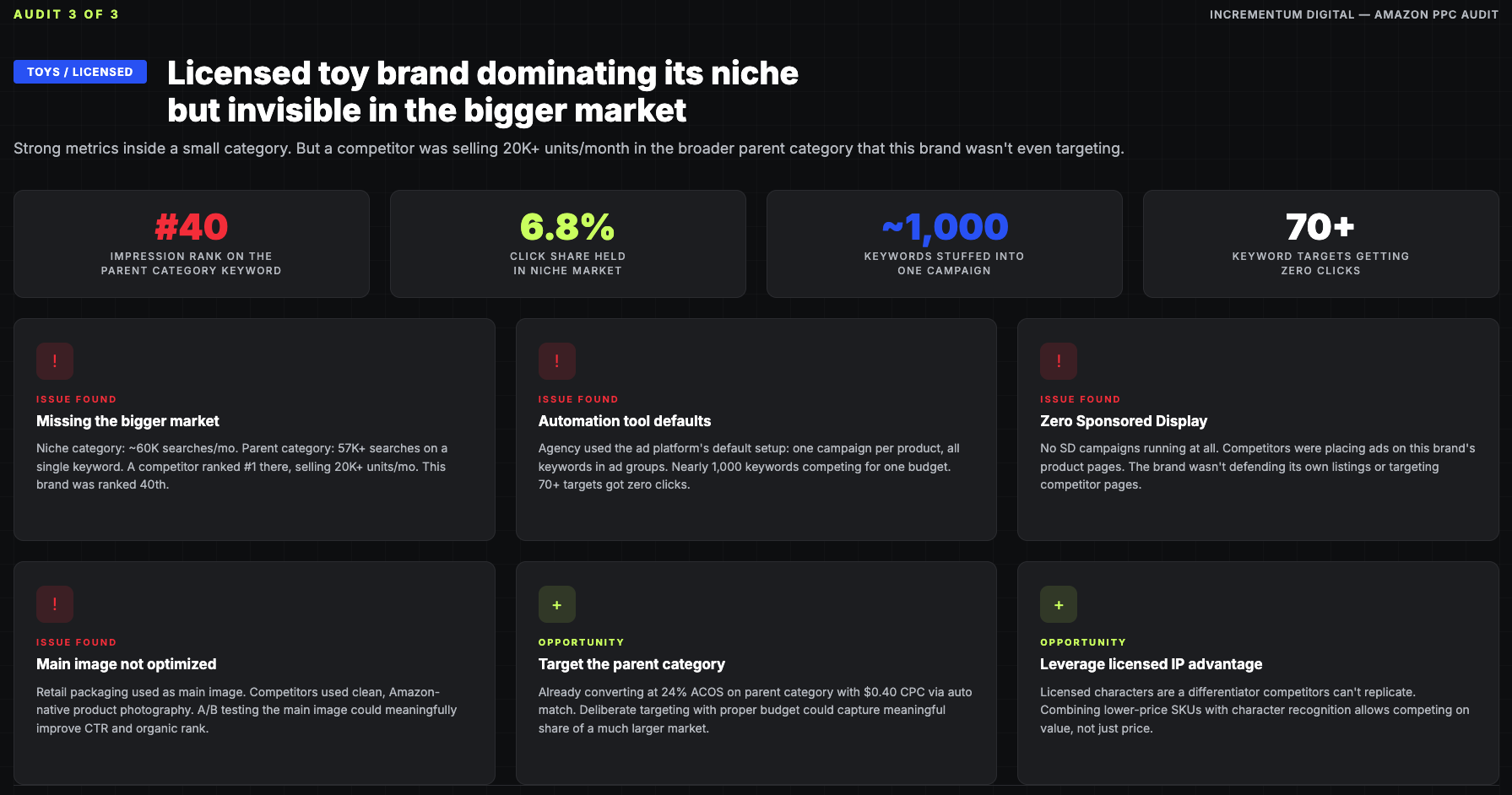
The biggest issue wasn’t inside their ad account. It was the market they weren’t going after. Their niche category generates roughly 50,000–60,000 searches per month on Amazon. But the broader parent category — which their product absolutely belongs in — generates over 57,000 searches per month on a single keyword alone. A competitor had recently entered that broader market aggressively and was already selling 20,000+ units per month, ranking number one in the parent category.
The brand was ranked around 40th in impressions for that parent category keyword. They had some spend there — $1,400 — and a decent ACOS of 24% with a very low CPC of $0.40. But they weren’t targeting the term strategically. It was showing up through auto or broad match, not as a deliberate campaign. The market opportunity was enormous, and they were barely participating.
Inside the account, the campaign structure told a familiar story. Their agency was using an automation tool’s default setup, which creates one campaign per product with ad groups for each match type. The result: nearly 1,000 keywords in a single campaign, sharing one budget. Over 70 keyword targets within those campaigns were getting zero clicks — not because they were bad keywords, but because they couldn’t win impressions when competing against hundreds of other targets for the same budget pool.
Branded and category keywords were mixed together. Auto campaigns weren’t negated for branded terms. No Sponsored Display campaigns were running at all — which meant competitors were placing ads on this brand’s product pages while the brand wasn’t defending its own real estate or targeting competitor pages.
The keyword harvesting numbers: 74 of 193 converting search terms were not being targeted in exact match, and 117 were not in phrase match. And crucially, almost none were being targeted in Sponsored Brand ads.
There was also a listing optimization opportunity. The brand’s main images were essentially retail packaging photos — the kind of image that works on a physical shelf but underperforms on Amazon, where the main image is competing with dozens of others in search results. Amazon’s Manage Your Experiments tool makes it possible to A/B test main images directly, measuring the impact on click-through rate and sales — and third-party tools like PickFu and IntelliVy can provide faster directional data by polling real Amazon shoppers.
The brand held 6.8% click share in their niche. Healthy, but with significant room to grow — especially if they expanded into the adjacent, much larger category and improved their visual presence in search results.
The patterns that show up in almost every Amazon ad audit
These three brands operate in completely different categories, at different scales, with different agencies managing their accounts. But the issues we found overlap significantly. That’s what makes a comprehensive PPC audit valuable — the same structural problems show up whether you’re a B2B brand selling through Amazon Business or a consumer brand running seven figures in ad spend.
Here’s what we see in nearly every Amazon advertising audit we run:
Campaign structure that limits control and visibility
Hundreds or thousands of keywords in a single campaign. Branded and unbranded mixed together. Match types combined. Auto campaigns not negated for branded terms. The result: you can’t tell what’s actually working, you can’t scale what’s converting, and many of your keywords are starved of impressions. This is the single most common — and most impactful — structural issue we find.
No systematic keyword harvesting
Across these three audits, the brands were leaving between 53% and 93% of their converting search terms untargeted in exact match. That means the majority of their proven, sales-driving keywords were operating without direct bid control. They couldn’t be individually scaled, couldn’t be isolated for budget allocation, and couldn’t be tracked for performance independently. Our keyword harvesting guide walks through the full process.
Ad types left on the table
Two of the three brands were running zero Sponsored Display campaigns. One was running zero Sponsored Brands. These aren’t optional ad formats — they serve different functions in the customer journey and offer placements (like competitor product pages, below the buy box, and headline banners) that Sponsored Products simply can’t access. Amazon’s own Prime Day strategy guide found that advertisers using all three formats together saw a 139% increase in sales versus average category growth.
Low impression share on high-value keywords
All three brands held single-digit percentage click share in their primary markets. In each case, they had keywords with strong conversion rates where they were ranked 10th, 15th, or 40th in impressions. The market was there. The conversion ability was proven. They just weren’t showing up enough.
Budget misallocation hiding in plain sight
Strong campaigns running out of budget while high-ACOS campaigns continued spending unchecked. Branded spend being scaled unknowingly when category budgets were increased. In one case, inflated attribution from vCPM campaigns was masking the true efficiency picture entirely.
What an Amazon PPC audit won’t tell you
An audit is a diagnostic tool, not a crystal ball. It can identify structural problems, quantify missed opportunities, and benchmark your performance against what’s possible. It can’t guarantee outcomes — because outcomes depend on competitive dynamics, margins, listing quality, inventory, and a dozen other factors that interact with your ad strategy.
What a good audit does is give you clarity. It answers the question every brand eventually asks: “Is this as good as it could be, or are we leaving money on the table?”
In our experience, the answer is almost always the latter. Not because brands are doing everything wrong — most aren’t. But because Amazon’s advertising platform is complex enough that there are nearly always pockets of inefficiency, untapped opportunities, or structural choices made early on that no one has revisited. Even brands working with a digital marketing agency that handles SEO, PPC, and creative often find that their Amazon-specific campaign architecture hasn’t been evaluated with this level of depth.
What to do next
If you recognized any of these patterns in your own account, you’re not alone. These issues are common precisely because they’re easy to miss from inside the day-to-day of campaign management.
Here are a few places to start:
- 3 Hidden Leaks in Most Amazon Ad Accounts — A deeper look at the structural budget drains we see most often
- Amazon Keyword Harvesting: The Complete Guide — How to build a systematic process for promoting converting search terms
- How to Lower Your TACOS and Boost Profitability — The framework for understanding the relationship between your paid and organic performance
And if you want someone to look at your specific account, request a free Amazon PPC audit. Our audit services cover campaign structure, keyword coverage, competitive positioning, ad type diversification, and attribution accuracy — the same comprehensive review you saw in the three examples above. No generic report. No commitment. Just an honest read on where things stand.
Incrementum also offers ads-only Amazon PPC management.





LET’S DISCOVER WHAT’S POSSIBLE FOR YOUR BRAND
We’re here to listen and uncover opportunities tailored to your unique goals.
Fill out the form to get started, and you’ll walk away with real insights and actionable recommendations—whether we work together or not.
- HANDS-ON LEADERSHIP
- AWARD-WINNING PARTNERSHIPS
- CUSTOM-BUILT SOLUTIONS