Amazon Advertising
5 Structural Decisions That Decide Whether Your Margin Survives, Based on Real Amazon PPC Agency Data

A brand we audited recently was spending around $1 million a year on Amazon ads. Their ACOS sat in the mid-20s. Almost 70% of their revenue was coming from ads, meaning organic was barely contributing. When they pushed their current Amazon PPC agency on why ACOS kept climbing as they tried to grow, the answer they got back was: “lower the bids.”
Learn How to Make Listings That Convert in 2025!
Read our step-by-step guide on how to optimize your listings using Rufus AI insights. Sign up for our newsletter and get your copy for free!
Show me howLowering bids doesn’t fix that problem. It hides it. The actual issue wasn’t a single bid in the account — it was five structural decisions made months before anyone ran a search term report. The same five we see misfire on nearly every plateaued account that walks through our door.
When the account structure isn’t built to absorb growth, no amount of Amazon PPC scaling tactics will make the margin math work. The bid strategies and budget allocations that worked at $50K/month start producing diminishing returns at $200K/month — not because they were wrong, but because the underlying decisions were.
The pressure on scaling cleanly keeps increasing. Amazon’s own Q4 2025 earnings put full-year 2025 advertising services net sales at $68.6 billion, up 22% year-over-year — the fastest-growing segment in the business after AWS. Q4 alone drove $21.3 billion in ad revenue, up 23%. More brands are pouring more money into Amazon ads than ever. Few of them are scaling profitably.
Think of this less as an Amazon PPC scaling tutorial and more as a structural diagnostic. If you’re trying to scale Amazon ads profitably and your ACOS keeps drifting the wrong direction, or if you’re evaluating an Amazon PPC management agency for a scaling phase, the list below is where the leak actually lives.
Why do brands struggle to profitably scale Amazon PPC advertising?
Because scaling is a structural problem disguised as a tactical one. The tactics that grew your account from $10K/month to $50K/month — tighter match types, smarter dayparting, aggressive negative keywords — start producing diminishing returns when you push past $100K/month. Not because the tactics stopped working, but because they were built on structural assumptions that no longer hold: that your catalog distribution is balanced, that your conversion rate is stable, that your organic rank is defensible, that your ROAS target is uniform across SKUs. Every one of those assumptions breaks at scale.
The answer isn’t more tactical sophistication. It’s revisiting the five structural decisions below before you push another dollar.
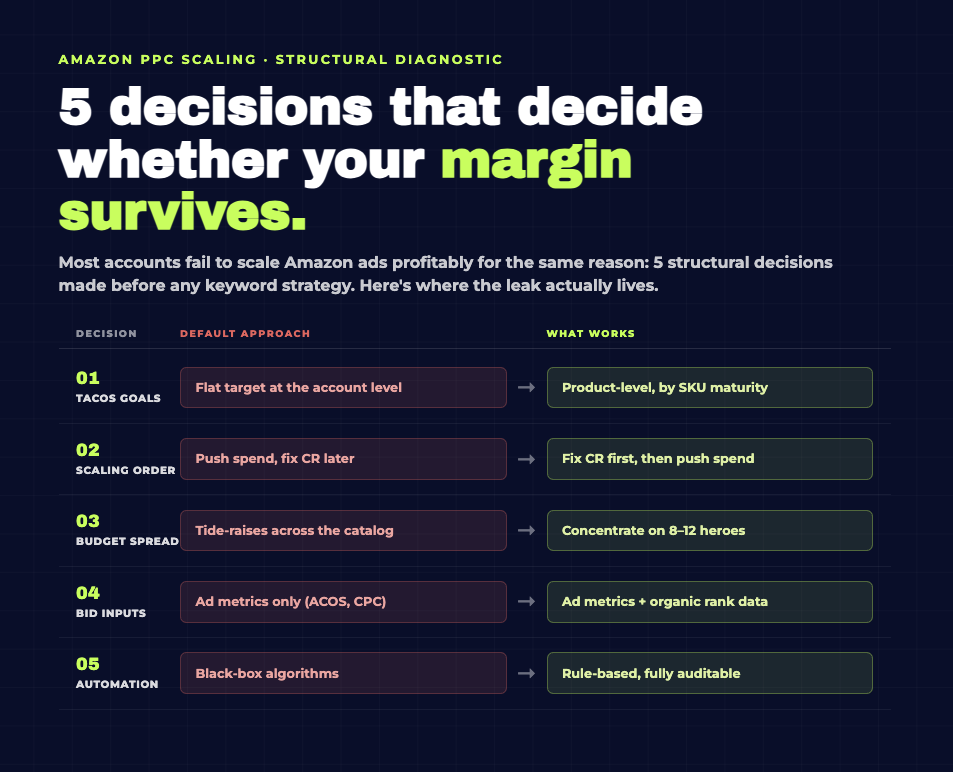
Most plateaued Amazon accounts share the same five structural problems. Get them right and ACOS holds as ad spend grows. Get them wrong and “lower the bids” won’t save the margin.
The five structural decisions that decide your margin
- Setting a single TACOS or ROAS target at the account level instead of the product level
- Pushing spend before fixing conversion rate
- Spreading budget across the catalog instead of concentrating on heroes
- Running automated bidding without organic rank context
- Using black-box automation tools you can’t audit
1. Account-level TACOS goals instead of product-level TACOS goals
The default agency approach is to set one TACOS or ROAS target across the entire account — say, “we’re optimizing to a 15% TACOS” — and apply it uniformly to every campaign.
It works at small scale because the catalog distribution is simple. A handful of hero SKUs carry the volume, and their performance averages out the newer or lower-velocity products.
It breaks at scale because every SKU in your catalog is at a different stage of maturity. A new launch needs ad investment the way a startup needs runway — low ROAS, high organic rank payoff down the road. A mature product with strong review count and organic visibility can support a much tighter TACOS because ads are defending rank, not building it. When you apply a 15% TACOS target to both, the launch suffocates and the mature product leaves efficiency on the table. Amazon’s own ACOS guide underscores the point: ACOS only measures what ads sold; it doesn’t account for the organic halo or product maturity that should shape the target in the first place.
What actually works: set TACOS or ROAS goals at the product level, not the account level. New launches get permission to run inefficient for a defined ramp period. Maturing products get stepped-down TACOS targets as review velocity and organic rank build. Mature products get profitability targets. The account-level TACOS becomes the weighted output of those product-level decisions — not the input.
For reference: across the brands we manage at Incrementum, our average client runs at roughly a 14-15% TACOS once the product-level structure is in place. That’s not a target to copy blindly — your right number depends on category, margin, and whether your traffic is mostly Amazon-native or fed by off-platform brand demand — but it’s a useful benchmark when an Amazon PPC management agency tells you a 25% TACOS at scale is “just how the category runs.” Often, it’s not. (For a broader breakdown, our TACOS optimization guide walks through the math.)
2. Pushing spend before fixing conversion rate
The default Amazon advertising growth strategy when a brand wants to scale is to increase budgets first and optimize later. “Let’s get to $150K/month spend, then we’ll work on the listing.”
It feels intuitive because more spend should equal more sales. And it does — in the short term. What it hides is the cost-per-sale math. If your main image, A+ content, and review count are producing a 12% conversion rate at current spend, doubling your ad budget doesn’t suddenly produce a 15% conversion rate. You just pay for twice as many clicks at the same 12% CR. ACOS climbs proportionally. Margin compresses.
The inverse is what actually works. Lift the conversion rate first — better main image, stronger A+ content, infographic listing photos, targeted coupons or brand-tailored promotions, review acceleration. A 12% CR going to 16% CR means the same ad spend produces 33% more sales, which compounds across every scaling dollar you add after. Agencies that skip this step and go straight to “more keywords, higher bids” are spending their client’s budget to subsidize a conversion problem.
Our post on 5 signs your Amazon PPC is bleeding money covers the specific CR leaks to check before scaling.
3. Spreading spend across the full catalog instead of concentrating on heroes
The default approach to scaling ad spend across a 50-SKU catalog is to raise the tide — small budget bumps across every ASIN, every campaign. It feels fair and it looks thorough on a reporting slide.
It breaks at scale because Amazon’s algorithm rewards concentration. Review velocity, organic rank, and social proof all compound faster when a single SKU is getting aggressive daily traffic than when 50 SKUs each get a trickle. Our internal benchmark for any reasonably competitive category: a hero SKU needs at least $10K/month in dedicated ad spend to build the review velocity and ranking momentum that turns ads into organic halo over 6-12 months. Spread $200K/month across 50 SKUs at roughly $133/day each, and you fund none of them at that threshold. Concentrate the same $200K on 8-12 hero ASINs at $500-$700/day each, and each one is funded above the line.
The other half of this decision is what NOT to do. Products you list and then leave un-funded don’t sit neutrally — they accumulate negative algorithmic history. Amazon tracks conversion rate, sales velocity, and engagement from day one. A product that sits with zero sales for three months becomes harder to rank later than a brand-new listing would. Every catalog SKU you keep without ad support is creating a future uphill battle.
What actually works: identify the 8-12 SKUs with the strongest margin, defensibility, and organic momentum, and fund them like you mean it. The rest of the catalog gets either a maintenance budget, a defensive budget, or a deliberate decision to delist. This feels uncomfortable — many brand owners resist it because they want “everything to work” — but it’s what Amazon’s algorithm actually rewards. For more on this tradeoff, see our profit vs. scale guide and our breakdown of campaign structure for long-term success.
4. Running automated bidding without organic rank context
The Amazon PPC agency that audited brand from our intro had a recurring response when ACOS climbed: “lower the bids.” It’s the answer almost every automation-first agency reaches for, because automated bid systems — whether Amazon’s own dynamic bidding strategies or third-party rule engines — treat ads as a closed system. The bid rules respond to ad metrics: ACOS, CPC, conversion rate, impression share. They don’t look at organic rank.
That’s a problem when you scale. If ads are outranking your own organic listing for a given keyword, every ad sale is potentially a sale that would have come in organically anyway. You’re paying Amazon ad fees to cannibalize your own organic revenue. At $50K/month spend, the cannibalization is a rounding error. At $200K/month, it can be the difference between a 15% TACOS and a 24% TACOS on the same product.
What actually works: track organic keyword rank as part of ads management, not separately. Before raising or lowering a bid on a keyword, check where your product ranks organically for that search term. If you’re already in the top 3 organic positions, aggressive ad bids are burning margin to move a customer from an organic click to a paid click. If you’re in positions 10-20, ads make sense as a rank-building investment. The decision is keyword-specific, and it requires rank data the default automation stacks don’t look at.
This is also why “lower the bids” is the wrong answer when ACOS climbs. The bid is the symptom, not the cause. The Amazon PPC management agency that lowers bids without diagnosing whether the listing’s conversion rate has dropped, whether the organic rank has slipped, or whether a competitor has launched a new ASIN at a better price point is treating the dashboard, not the account.
5. Black-box automation tools you can’t audit
The default “scaling stack” at many Amazon PPC management agencies is a third-party automation platform that optimizes bids and budgets on autopilot. It looks efficient in a sales pitch. The agency plugs it in, the tool makes decisions, and the client gets a monthly report.
It breaks at scale because you can’t debug what you can’t see. When ACOS spikes on a Tuesday, you need to know which bid changed, which keyword got promoted, which rule triggered — not “the algorithm adjusted.” Black-box tools produce outcomes without exposing the decision logic. When those outcomes are bad, the only levers your agency has are “turn the dial up” or “turn the dial down.”
What actually works: rule-based automation where every rule is explicit, readable, and editable. Scaling an account past $100K/month in monthly ad spend is a hourly-cadence operation during sales events and a daily-cadence operation the rest of the time. You need to know — and your agency needs to know — exactly why a campaign paused, why a bid moved, and why a budget got reallocated. Amazon’s own Sponsored Products best practices explicitly recommend reviewing bids at least every two weeks and preparing for dynamic bidding to double your input bid in high-conversion windows — a level of oversight that black-box platforms structurally can’t give you. Anything less makes it impossible to tell whether you’re scaling profitably or just scaling fast.
What to look for in an Amazon PPC agency for scaling
If you’re evaluating an Amazon PPC management agency specifically for a scaling phase, the five structural decisions above double as a filter. The best Amazon PPC agency for scaling fast isn’t the one with the most aggressive bid strategy or the fanciest dashboard. It’s the one that gets the structure right before it touches a single campaign — and the one whose first response to a climbing ACOS is to diagnose the foundation, not lower the bids.
Five questions worth asking any prospective Amazon PPC agency before you sign:
- Do you set TACOS goals at the account level or the product level? If the answer is “account level,” you have your answer.
- How do you handle new-launch SKUs vs. mature SKUs in the same catalog? Flat ROAS targets across both is a structural red flag.
- Do you track organic keyword rank as part of ads management? If ads and organic are managed in separate silos, cannibalization is going to happen at scale.
- What bid automation tool do you use, and can I see the rules? If the answer is “our proprietary algorithm, we can’t share the rules,” that’s a black box you can’t audit.
- How often does the account manager actively review the account during a scaling push? Weekly is too slow. Daily is the floor. Hourly is the standard during major events.
For FBA brands specifically, the top Amazon PPC agency for scaling FBA brands is the one that understands your FBA fee structure, inventory constraints, and cash-flow cycle well enough to pace the scaling push against your restock cadence. Running out of inventory mid-scale is a faster margin killer than any bid mistake. An Amazon PPC agency that pushes 2-3x daily ad budgets without checking your inventory cover is going to leave you ranking on a out-of-stock listing — which Amazon penalizes for weeks after you restock.
For more on the in-house vs. agency decision at scale, including the real math on whether an Amazon PPC management agency pencils out for a seven-figure seller, see our agency vs. DIY real-math breakdown. And for a sense of what audits typically uncover, our post on what an Amazon PPC audit finds walks through three real brand examples with actual data.
The takeaway
Scaling Amazon PPC campaigns profitably isn’t a tactical challenge. It’s a structural one. The tactics — bid modifiers, match type discipline, dayparting — matter, but only when they’re layered on top of the right structural decisions. Account-level TACOS, spend-first scaling, catalog-wide budget spread, rank-blind automation, and black-box tools each work fine at small scale and each break predictably as ad spend grows.
The brand we audited at the top of this post didn’t have a keyword problem. They had five structural problems that no amount of “lower the bids” was going to fix. The same is almost certainly true of your account if your ACOS is drifting the wrong way.
Fix the structure first. The tactics will do their job once they have a foundation to sit on.
Get a free Amazon ad audit before your next scaling push
If your ACOS has been climbing as your ad spend has grown, or you’re not sure whether your account structure is ready to absorb the next 2-3x in budget, our team will walk your account for free and flag the structural issues before they start compounding.
Request your free Amazon ad audit →
Incrementum also offers ads-only Amazon PPC management.





LET’S DISCOVER WHAT’S POSSIBLE FOR YOUR BRAND
We’re here to listen and uncover opportunities tailored to your unique goals.
Fill out the form to get started, and you’ll walk away with real insights and actionable recommendations—whether we work together or not.
- HANDS-ON LEADERSHIP
- AWARD-WINNING PARTNERSHIPS
- CUSTOM-BUILT SOLUTIONS