Amazon Advertising
First 90 Days on Amazon: A Brand Launch Playbook
A brand new to Amazon starts with nothing the platform can read. No sales history. No reviews. No organic rank. No search-term data inside the ad account. The first 90 days on Amazon produce the data that every later decision depends on. That makes the sequence of the work more consequential than the size of the budget behind it.
Learn How to Make Listings That Convert in 2025!
Read our step-by-step guide on how to optimize your listings using Rufus AI insights. Sign up for our newsletter and get your copy for free!
Show me howWe manage Amazon advertising and operations for brands from seven to nine figures in annual Amazon revenue. Many of our launches started from a true cold start, and each one began from a different position. In this blog post, we will look at a globally recognized licensed toy brand that entered a fixed movie release window with no live paid signal, a premium home brand carried strong direct-to-consumer demand and never sold on Amazon before the launch, and a challenger oral care brand entered its category against legacy players with no recognition on the platform at all.
This post covers what we built in each case, in what order, and what the first 90 days on Amazon returned. The numbers come from the three published case studies linked throughout.
What does a cold start on Amazon actually mean?
A cold start on Amazon means the brand launches with zero sales history, no reviews, and no organic ranking, and the ad account carries no search-term data to scale on. Amazon’s advertising algorithms and its organic ranking both read historical performance. A cold-start account gives them nothing to read, so the first job is to generate signal rather than to buy volume.
Cold start is a data condition, not an awareness condition. The licensed toy brand carried decades of cultural recognition and a movie release that pulled demand on its own. Its Amazon account still held no recent search-term data across the brand’s five marketplaces. Off-Amazon awareness and in-platform signal are separate assets, and a brand can hold one and lack the other.
Why does the first 90 days on Amazon matter more than the first year?
The first 90 days on Amazon set the keyword list, the ASIN priorities, and the conversion baseline that the rest of the year scales against. Every campaign a brand runs in month six inherits the search terms and the bid history created in months one through three. Bad early data compounds.
The practical effect is that spend deployed early buys information, and spend deployed later buys volume. Run in that order, a launch identifies its real demand cheaply. Run in reverse, a launch pays premium CPCs for the same information.
What do you build in days 1 to 30?
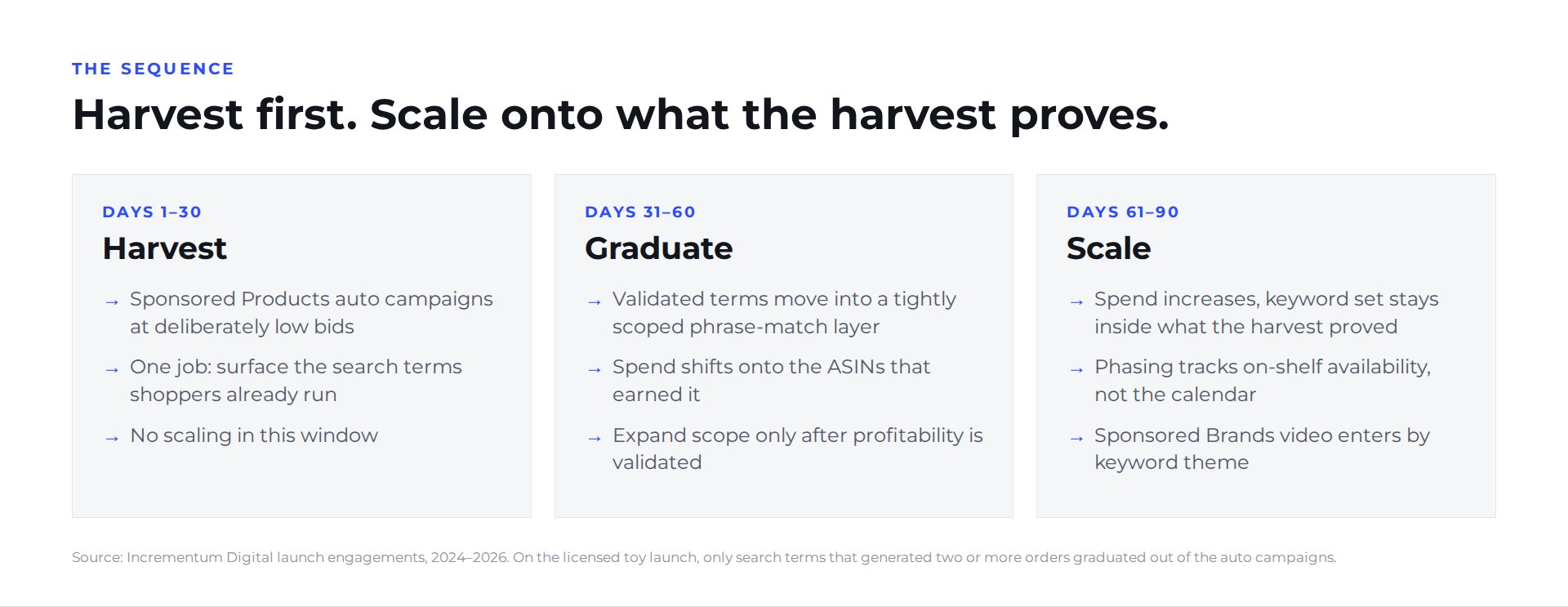
In days 1 to 30 we harvest. We launch Sponsored Products auto campaigns at deliberately low bids with one purpose, which is to surface the search terms shoppers already run against the catalog. We do not scale in this window.
The licensed toy launch across Amazon and Walmart shows the discipline clearly. Amazon auto campaigns launched at low bids ahead of the release, and only search terms that generated two or more orders graduated into a phrase-match layer. The team refused to bid up on character head terms even as competitive pressure climbed through the launch window. The reasoning was specific to the brand. The movie already pulled demand, so premium CPCs bought nothing that brand recognition did not deliver on its own.
The oral care brand required a different day-one build because the brand had no recognition to lean on. We restructured campaigns by match type with exact match prioritized, segmented by brand intent, and set separate ACOS targets per segment. Long-tail keywords carried the efficient conversions while we isolated high-ACOS, high-traffic terms for budget control.
Both builds share one property. Neither one guessed. For more on this stage, see our guide to keyword harvesting in Amazon advertising.
What do you build in days 31 to 60?
In days 31 to 60 we graduate the winners. Validated search terms move from auto campaigns into a tightly scoped phrase-match layer, and spend shifts onto whichever ASINs earned it during the harvest phase.
The licensed toy launch produced a useful result here. Spend moved onto the ASINs and terms that performed in the harvest phase rather than onto the SKUs anyone predicted in advance. The catalog leader turned out to be the signature villain ASIN, which returned 8.75x ROAS, ahead of the franchise hero. The harvest phase found that. A pre-set SKU plan does not.
The premium home brand applied the same principle to keyword scope rather than to ASINs. We built the campaign structure around long-tail and branded search queries where the brand held a natural edge, and we expanded into broader terms only after profitability was validated. Off-Amazon awareness converted into marketplace orders through branded capture rather than through a broad-match fight over head terms.
A clean campaign structure makes this stage possible. Our guide to Amazon ad campaign structure covers the architecture we use.
What do you build in days 61 to 90?
In days 61 to 90 we scale onto proof. Spend increases, and the keyword set stays inside what the harvest validated.
The toy brand’s Walmart Connect program is the cleanest illustration, because the phasing tracked on-shelf availability rather than a fixed calendar. March ran a small harvest phase to surface the terms that converted, before any licensed SKUs had landed on shelves. As those SKUs arrived in early April, the campaign scaled directly onto the keywords and SKUs the harvest phase had validated. The full window delivered $242,000 or more in ad sales at 5.81x blended ROAS on Sponsored Products alone.
The efficiency pattern across those two months is the point. March efficiency came from low spend on already-converting terms. April efficiency came from higher spend held to the keyword set March validated. April could be aggressive because it was not speculative.
Creative belongs in this window as well. The oral care brand ran humorous, lifestyle-driven Sponsored Brands video and static ads, each aligned to a specific keyword theme across whitening, sensitivity, kids, and enamel care. The video variations that framed the product as an at-home version of a professional visit produced the highest CTR and CVR in the account.
How do you launch on Amazon without cannibalizing your D2C site?
You launch on Amazon without cannibalizing D2C by separating the two channels on price, promotion, and inventory before the first campaign goes live. The premium home brand’s Amazon launch was built on that separation, which we call channel harmony.
Leadership at the brand worried that Amazon would erode established website revenue. Three decisions addressed the concern directly:
- We kept premium pricing year-round and limited promotional activity to major tentpole events only. That protected the brand’s positioning against mass-market alternatives priced far below it.
- We strengthened the D2C advantages, including free shipping, so the website kept reasons to be the preferred destination.
- We decoupled inventory. The brand originally shipped only slow-moving D2C stock to Amazon. We built a category-level demand forecast, benchmarked the brand’s early trajectory against niche growth rates, and secured agreement to allocate separate inventory for Amazon.
The brand finished its first year on Amazon at $3.2 million in revenue, earned number one rankings on key long-tail terms, and saw organic sales outpace paid by year’s end. D2C revenue held, and both channels ran profitably in parallel.
How much budget does an Amazon launch need in the first 90 days?
An Amazon launch needs less budget than a conventional launch plan assumes, provided the harvest phase runs first. The licensed toy brand covered six markets across two retail-media channels on under $85,000 in combined spend.
One measurement decision made those numbers legible. We measured Amazon against total revenue rather than ad-attributed sales alone. For a brand that already pulls organic demand, ad attribution counts only what the click directly converted, which understates what an awareness-led launch returns. The gap between $288,000 in ad sales and $600,000 or more in total revenue in the US market was the evidence. If your team reports on ad-attributed sales only, our breakdown of TACOS versus ACOS explains why the fuller view matters during a launch.
What does a launch look like with no brand recognition at all?
A launch with no brand recognition puts awareness growth ahead of efficiency in the first 90 days, then converts that awareness into branded demand. The challenger oral care brand growth story began on Amazon in late 2024 against deep consumer loyalty to legacy oral care players. The brand started with no historical sales data and no reviews. CPCs ran high across whitening, enamel care, and sensitivity keywords.
The brand sustained a conversion rate of about 12% across more than 82,000 monthly sessions. Two tactics carried the awareness work. We targeted competitor ASINs during key buying periods to place the brand in front of relevant shoppers. We also repositioned whitening as a safe everyday routine rather than a clinical procedure. Daily monitoring ran on dashboards built from the Amazon Ads API, Helium 10, and Amazon Search Query Performance reports.
The patterns across all three launches
Four patterns hold across all three:
- Harvest precedes scale. Every launch spent small first to identify real demand, then spent larger against a validated keyword set.
- The data picks the hero SKU. The toy catalog’s leader was the villain ASIN, not the franchise hero. Pre-set SKU plans miss results like that.
- Total revenue is the launch metric. Ad-attributed sales understate an awareness-led launch, sometimes by more than half.
- Channel and price decisions come before campaigns. The premium home brand’s inventory and pricing agreements were secured before the first campaign went live.
What the first 90 days on Amazon will not deliver
The first 90 days on Amazon will not produce a mature review base. Reviews accumulate with order volume, and a launch account starts at zero. Plan the conversion rate expectation around that.
The first 90 days will not produce stable organic rank either. Organic rank follows sales velocity and relevance history, so it lags paid performance. The premium home brand reached number one on key long-tail terms and saw organic outpace paid by year’s end, not by day 90.
Inventory is the most common constraint we see on a launch, and it is the one an ad account cannot solve. A campaign that works will sell through stock faster than a D2C-only forecast plans for.
What to do next
If you plan an Amazon launch, start with the harvest architecture rather than the budget number. Three resources cover the adjacent decisions:
- How to launch a new product on Amazon successfully in 2026 for SKU-level launch mechanics inside an existing account.
- Amazon listing optimization: an updated guide for brands in 2026 for the conversion side of a cold start.
- Should you bid on your own brand keywords on Amazon? for the branded-capture question the premium home brand faced.
If you already sell on Amazon and want a read on what your account is leaving on the table, request a free Amazon ad review. We look at your actual account and send back a hosted review of what we find. No generic report, and no commitment.
Incrementum Digital manages Amazon advertising, operations, and growth strategy for brands from seven to nine figures in annual Amazon revenue, plus full TikTok Shop management and marketplace strategy across Walmart and beyond. Learn how we work.
Incrementum also offers ads-only Amazon PPC management.


LET’S DISCOVER WHAT’S POSSIBLE FOR YOUR BRAND
We’re here to listen and uncover opportunities tailored to your unique goals.
Fill out the form to get started, and you’ll walk away with real insights and actionable recommendations—whether we work together or not.
- HANDS-ON LEADERSHIP
- AWARD-WINNING PARTNERSHIPS
- CUSTOM-BUILT SOLUTIONS