How We Launched a Licensed Toy Catalog Across Amazon & Walmart Through a Tentpole Movie Window
Overview
This case study covers a globally recognized licensed toy brand with a tentpole movie release tied to its flagship character IP scheduled for Q2 2026. While the brand carried decades of cultural recognition and shoppers already knew the franchise on sight, both retail-media channels were entering the launch window on a cold start, with no live in-platform paid signal to inherit ahead of release. Amazon's five-marketplace footprint had no recent search-term data to scale on. Walmart Connect's pre-release window was similarly clean, with prior in-channel activity concentrated in earlier Q4 holiday cycles.
Our team identified that the issue wasn't demand creation; it was demand capture. With the movie acting as a built-in pull on the catalog, paying premium CPCs to "build awareness" would have meant teaching the algorithm something it could already infer from brand recognition alone. To unlock scalable growth, we built two parallel, awareness-led, harvest-first programs aligned to the known release window. Amazon ran across five marketplaces (US, UK, Germany, France, Spain) measured against total revenue rather than ad-attributed sales alone. Walmart Connect ran a concentrated, Sponsored Products-only push in the US, phased to the on-shelf product release.
The Challenge
Despite carrying decades of brand recognition and a built-in demand pull from the upcoming movie release, the catalog faced structural and timing constraints that made aggressive bidding the wrong move:
- Cold-start entry into both channels, with no live in-platform search-term data on Amazon or Walmart Connect ahead of the release window, requiring the team to surface real shopper intent from scratch rather than scale on historical signal
- Fixed-date tentpole movie release in Q2 2026, compressing the entire awareness-build-and-capture window into roughly six weeks before the launch peak
- Six-market coverage across two channels, including Amazon US, UK, Germany, France, and Spain plus Walmart Connect US, each with different demand maturity and reporting infrastruct
- Tightly capped cross-channel budget under $85K in combined PPC spend across the launch window, ruling out aggressive top-of-search bidding entirely
- Sponsored Products-only constraint on Walmart Connect, removing access to Sponsored Brands and Display layers that would normally carry awareness work during a tentpole launch
- Crowded licensed-toy competitive set across both retail-media platforms, with multiple sellers bidding hard on character keywords on Amazon and into the same launch window on Walmart Connect
Together, these dynamics meant that the conventional “outspend the field” playbook would have burned the budget without buying meaningful incremental visibility. The brand already owned the demand. The job was to capture it cleanly across both channels.
The Approach
AWARENESS-LED, UPPER-FUNNEL POSITIONING (AMAZON)
The category-default move would have been to bid aggressively on character head terms ahead of the movie release. We didn't. The IP already pulled demand on recognition alone, so paying premium CPCs to "build awareness" would have meant teaching the algorithm something the brand could deliver organically. Instead, we ran upper-funnel only and let the release window pull demand through a clean catalog rather than force it through a bidding war.
HARVEST-FIRST CAMPAIGN ARCHITECTURE
Amazon auto campaigns launched at deliberately low bids with one job: surface the search terms shoppers were already running ahead of the release. Only terms with two or more orders graduated into a tightly scoped phrase-match layer. Walmart Connect applied the same principle in time rather than in structure, with March as the low-spend harvest phase and April as the scale phase onto the keywords the harvest validated. Both channels kept decision-making evidence-based instead of speculative.
SIGNAL-DRIVEN ASIN PRIORITIZATION
Most launch programs pre-decide which SKUs carry the spend. We let the data pick. As the launch window approached on Amazon, spend shifted onto whichever ASINs and search terms earned it through harvest-phase performance. The breakout was counterintuitive: not the franchise's headline hero, but the signature villain ASIN, which led the catalog at 8.75x ROAS and 11.43% ACoS.
PRODUCT-RELEASE-ALIGNED SCALE (WALMART CONNECT)
Walmart spend tracked on-shelf availability rather than a fixed calendar. With no live in-platform signal heading into release, March ran a small harvest phase to surface the terms that converted. As the licensed product SKUs landed on shelves in early April, the campaign scaled onto exactly the keywords and SKUs the harvest had validated. The phasing meant April could be aggressive without being speculative.
TOTAL-REVENUE MEASUREMENT FRAMEWORK
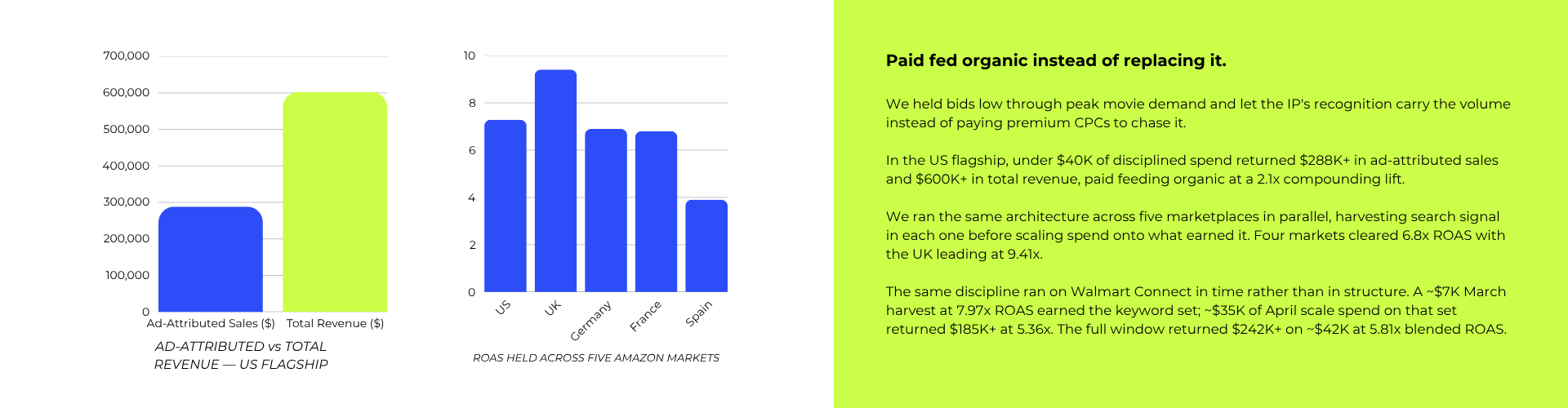
We measured Amazon against total revenue, not ad-attributed sales alone. For a brand that already pulls organic demand, PPC attribution understates the business impact of an awareness-led campaign by counting only what the click directly converted. Tracking total revenue captured the compound effect of paid feeding organic. The 2x+ gap between the two in the US flagship was the proof.
Our Results
Client's Q2 target hit before quarter-end on a sub-$85K combined budget
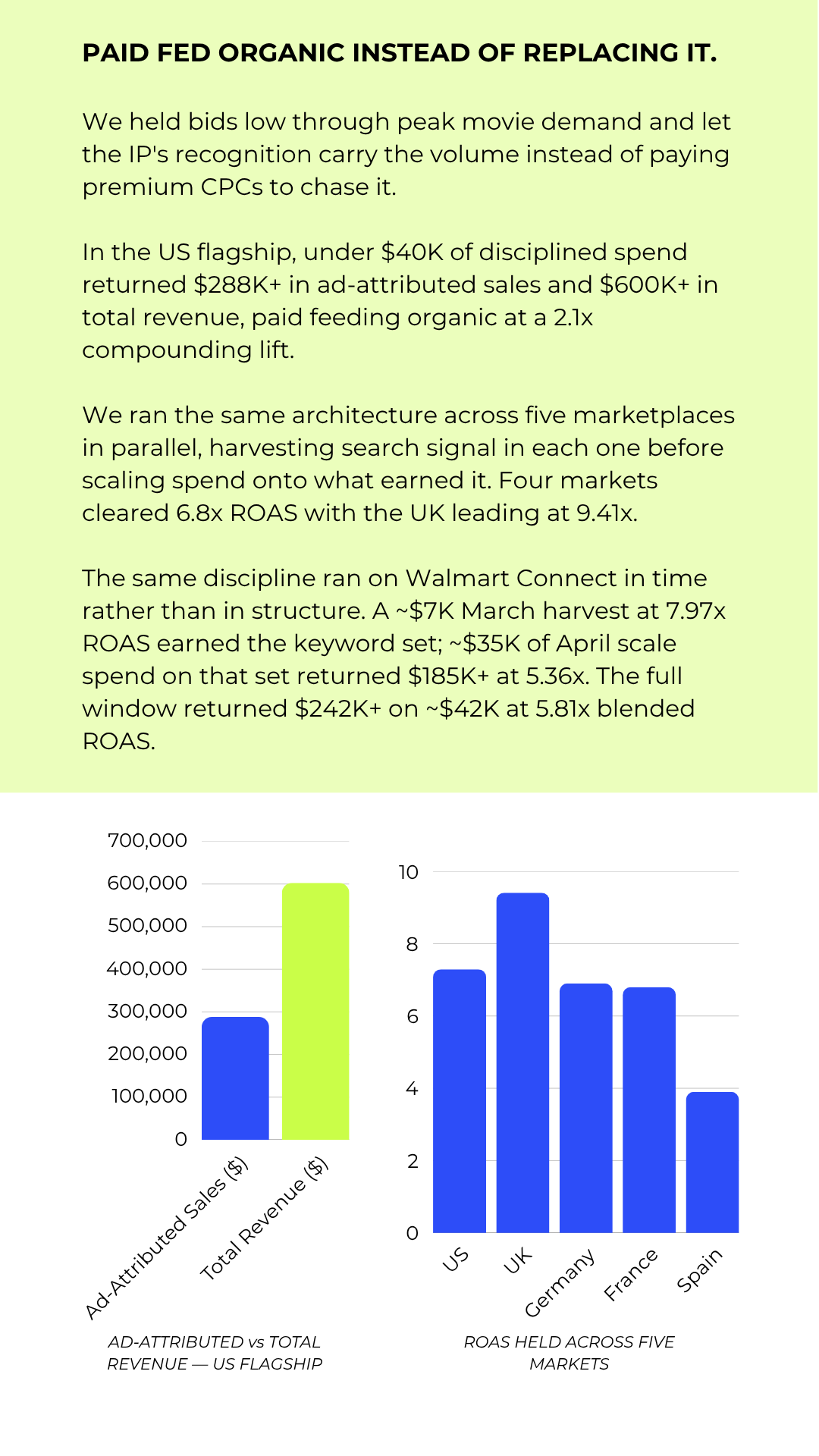
Amazon US: $600K+ total revenue on $288K+ ad sales, 2.1x paid-to-organic lift
Discovered that villain ASIN outperformed the franchise hero at 8.75x ROAS, 11.43% ACoS
Amazon EU: UK 9.41x, Germany 6.9x, France 6.8x ROAS on ~€5K combined EU spend
Walmart Connect: $242K+ ad sales at 5.81x blended ROAS, Sponsored Products only