Amazon Advertising
External Traffic to Amazon for Prime Day 2026: The Alexa for Shopping Playbook
Amazon has officially confirmed that Prime Day is moving to June this year, the first time since the program launched that it has not landed in July. Exact dates haven’t been published yet, but the inventory cutoff schedule Amazon shared (May 27 for AWD and minimal-split FBA, June 5 for Amazon-optimized splits) points to a mid-to-late June window. On Incrementum’s May monthly update with CEO Liran Hirschkorn and Director of Ads Mansour Norouzi, Liran’s read is that the event will run four days toward the end of June, in part because Amazon wanted the revenue inside Q2 and out of the way before back-to-school traffic builds.
Learn How to Make Listings That Convert in 2025!
Read our step-by-step guide on how to optimize your listings using Rufus AI insights. Sign up for our newsletter and get your copy for free!
Show me howIn Q1 2026, traffic to U.S. retail sites from generative AI sources grew 393% year over year, according to Adobe’s April 2026 retail analytics report. The conversion shift underneath that growth matters more than the volume number. In March 2025, AI-referred visitors to U.S. retail sites converted 38% worse than non-AI traffic. In March 2026, they converted 42% better. That is a phase shift in how AI-driven traffic performs on retail sites. The consumer side of the same story: as of May 2026, NielsenIQ found that 42% of U.S. shoppers had used at least one AI tool to shop within the past month.
For Prime Day 2026, this changes what external traffic to Amazon is actually for. Sessions to your PDP from Google, social, and email still matter. The new layer underneath is the citation density, branded search velocity, and off-Amazon presence that AI shopping surfaces (Rufus, now Alexa for Shopping) use to decide which brands to recommend in a conversational query. The brand AI surfaces by name in that conversational query wins the consideration phase before a Sponsored Products bid is placed.
What Amazon changed on May 13, 2026
On May 13, 2026, Amazon renamed Rufus to Alexa for Shopping and shipped a set of new capabilities that change how shoppers discover, compare, and buy on the platform. Per Amazon’s own framing, Alexa for Shopping is positioned as a conversational AI assistant that “combines deep product knowledge, in-depth information from across the web, and powerful shopping capabilities with your personal preferences.”
Five features ship with the May 13 launch that matter for Prime Day strategy:
- Account memory. The assistant retains individual shopping history and tailors recommendations based on it.
- Dynamic product comparisons. Side-by-side answers to questions like “which of these two for my use case” without the shopper navigating between PDPs.
- Up to one year of price history. Shoppers can see whether the current price is a real discount or a return to baseline.
- Agentic auto-buy at target prices. A shopper sets a price target and the assistant executes the purchase when the item hits it.
- Personalized shopping guides. AI-generated bundles and category guidance based on prior shopping activity.
The auto-buy feature is worth flagging separately. A shopper who set a target price three weeks before Prime Day will close automatically when Day 1 activates, regardless of whether you advertised to them that morning. That has implications for how Sponsored Products budget gets paced on Day 1 versus the pre-event window, which we come back to in the pricing discipline section below.
This is the surface where AI-mediated shopping research and purchase decisions are now happening. The question for Prime Day 2026 is what your off-Amazon presence looks like to it.
Sponsored Prompts: the new on-Amazon AI surface to plan around
The Alexa for Shopping rebrand wasn’t the only AI surface that shifted on Amazon in May. Sponsored Prompts, the paid AI questions that surface inside conversational answers on product detail pages, moved from preview to default-on across most ad accounts in the same window. They’re worth discussing alongside the off-Amazon playbook because the attribution math they introduce changes how Sponsored Products performance reads during Prime Day.
Our team pulled spend data across six brand accounts and 165 unique prompts during the May rollout. A few patterns:
- Strong click-through, ambiguous lift. The five AI-generated questions that surface on a product page get high engagement when shoppers see them. Whether the resulting sale is incremental is the open question. A Sponsored Prompt only fires when a shopper is already on your PDP, which means most of those shoppers arrived through another paid surface. If the prompt now claims the attribution, the original ad’s report is understating its real contribution.
- Defensive-only placement. Sponsored Prompts don’t fire on competitor PDPs. The current placement is purely on top of traffic you already own, which makes the spend a tax on shoppers who landed on your listing rather than a path to new ones.
- On by default. The campaigns can be paused, but they run unless you turn them off.
For Prime Day, the practical move is to pull the Sponsored Prompts report the week before the event and decide whether the engagement is incremental enough to justify the budget pull from Sponsored Products. For most accounts in our portfolio, the defensive-only placement makes Sponsored Products the more leveraged spend during the four-day window. The off-Amazon channel work covered below is what drives net-new shoppers to the PDP. Sponsored Prompts is a question of how that arriving traffic gets attributed once it lands.
Why this reframes what external traffic is for
The traditional model for external traffic to Amazon is straightforward: spend money or content effort off-Amazon to drive sessions onto your PDP, where Sponsored Products and your listing’s conversion math close the sale. That model still works. It is no longer the whole story.
In the AI-mediated shopping environment, external traffic does a second job. Off-Amazon content, citations, and branded search activity feed the signals that AI shopping surfaces use to decide which brands to surface in a conversational query. A shopper asking Alexa for Shopping “what are the best running shoes under $100” is no longer doing a keyword search on Amazon. They are receiving a generated answer that names two or three brands. The brands named are the brands the AI surface has decided are credible, based on what it can see about each brand across its training and retrieval sources.
The economics on AI-referred traffic underline why this matters. Per Adobe’s Q1 2026 report, AI-referred visitors to U.S. retail sites show 12% higher engagement rate, 48% longer time on site, 13% more pages per visit, and 37% higher revenue per visit than non-AI traffic. eMarketer’s 2026 AI Commerce report adds that 16.7% of U.S. AI users now start product searches with an AI assistant rather than a traditional search engine or retail site.
For an Amazon brand, three signals determine whether AI surfaces include it in those generated answers:
- Branded search velocity. Shoppers searching your brand name on Amazon, Google, and elsewhere at rising rates tells AI surfaces the brand is established demand and weights it higher in generated answers.
- Citation density. The number and quality of times your brand appears in indexed sources (press coverage, product reviews, creator content, owned content). AI surfaces ingest from these. A brand with no off-Amazon citation footprint is invisible to them.
- Off-Amazon presence. Where the brand shows up beyond its own PDP. Google search results, social platforms, YouTube reviews, retail sites. The breadth of presence is itself a signal of established status.
None of these are new concepts. What changed is their weight. In a keyword-search world, a brand with weak off-Amazon presence could still win category search on Amazon through Sponsored Products and listing optimization. In an AI-shopping world, the AI’s recommendation can happen before the shopper ever loads a search results page. We covered the on-Amazon optimization layer in Is Your Amazon Strategy Ready for Rufus AI? and the broader AI-search optimization framework in our Generative Engine Optimization crash course. This post is the off-Amazon companion to those two.
The off-Amazon channel playbook for Prime Day 2026
The off-Amazon channels that build the AI shopping signal are largely the same channels you would use for awareness marketing. What changes is the goal underneath them. Each channel below earns its place because it produces measurable Prime Day session value, brand-recognition signal value, or both. The mix that matters for any given brand depends on category, audience, and current spend level.
Google: branded search demand
Branded search on Google is the cleanest leading indicator that a brand is being researched ahead of Prime Day. A rising branded search index in the four to six weeks before the event tells you off-Amazon activity is paying off (it also tells Amazon’s algorithm and AI shopping surfaces the same thing). The opposite is also true. Flat or declining branded search heading into Prime Day means your off-Amazon work is not producing recognition signal.
The practical work falls into two parts. First, defend branded queries on Amazon: Sponsored Brands placements on your own brand terms remain the lowest-CPC ad real estate on Amazon during Prime Day, and competitors will bid against your brand terms with deeper deals than usual. Our breakdowns on bidding on branded keywords and branded search budget allocation cover the on-Amazon side. Second, generate branded queries off-Amazon: PR, creator content, and Meta/TikTok activity drive shoppers to Google your brand name before they get to Amazon. That generation work has a lead time. The investments made in May and June move the needle in July, not the campaigns launched the week of the event.
TikTok and TikTok Shop
TikTok is the channel where shopping discovery and content discovery overlap most directly. Per eMarketer’s 2026 social commerce data, TikTok Shop sales grew 84% between March 2025 and February 2026. For Prime Day strategy, TikTok serves three functions simultaneously: direct social commerce (sales close on TikTok Shop), branded search generation (TikTok viewers Google or search Amazon for products they saw), and creator citation density (creator content gets indexed and surfaces in AI shopping responses).
The Amazon-TikTok partnership added a fourth function: direct shoppable links between TikTok content and Amazon PDPs. We covered the mechanics in Amazon’s TikTok Partnership: How It Works. For Prime Day, the strongest play is to seed creator content in the three to four weeks before the event, with shoppable links pointing to deal ASINs once the deal price activates on Day 1.
Meta, Instagram, and the creator economy
Meta and Instagram are the largest paid social channels for U.S. ecommerce and, separately, the largest hosts of branded creator content. Per eMarketer’s 2026 creator economy forecast, U.S. brands will spend $43.9 billion on creator partnerships in 2026, up from $29.5 billion in 2024. Nano and micro-influencers account for roughly half of that spend (49.9%), which means the creator strategy that works tends to lean on volume of credible voices at smaller scale rather than a single high-follower hero partnership.
For Prime Day, the two highest-leverage Meta plays are creator-led organic content (citation density and branded search generation) and retargeting paid social (closing warm audiences that researched the brand off-Amazon). The creator work needs to start at least three weeks before the event so the content has time to compound. The retargeting work runs concurrent to Day 1 through Days 3-4, picking up the warm cohort the deal price will close.
PR and press citations
PR coverage is the off-Amazon channel most underweighted relative to its AI shopping value. Press articles are high-trust sources that AI shopping surfaces ingest heavily during retrieval, which means a single article in a reputable outlet can outweigh dozens of social posts in shaping what AI says about your brand. For Prime Day, the press push has a long lead time (pitches usually need to land four to eight weeks before the event for tier-one outlets) and a narrow window of impact (press value compounds over months, but the Prime Day pitch needs to be specific and timely enough to land coverage in late June or early July).
YouTube long-form reviews
YouTube is the citation source AI surfaces lean on most heavily for product research queries. A long-form review video from a credible reviewer in your category builds two signals simultaneously: a citation that AI surfaces ingest, and a direct path for high-intent viewers to find your Amazon PDP through the video description. For Prime Day, sponsoring or seeding video review content in the four to six weeks before the event compounds across both pathways.
Owned email and SMS
Owned channels are the only ones that fire on demand. Email and SMS audiences built throughout the year become the branded-search spike machine in the week before Prime Day. An email or SMS blast at T-3 announcing that the brand will be participating in Prime Day (specific deal pricing stays under wraps until Day 1 per Amazon’s deal program terms) produces a measurable lift in branded queries on Amazon, which the algorithm and AI surfaces both register. For brands with a meaningful list, owned channels are the highest-leverage off-Amazon move available in the final week.
Timing: when each channel fires
The off-Amazon channels each work on different lead times. Off-Amazon work that runs concurrent to the on-Amazon ad ramp underperforms the same work staged across the four to six weeks before Prime Day. Each channel below has its own window where signal generation needs to happen for it to be useful during the event.
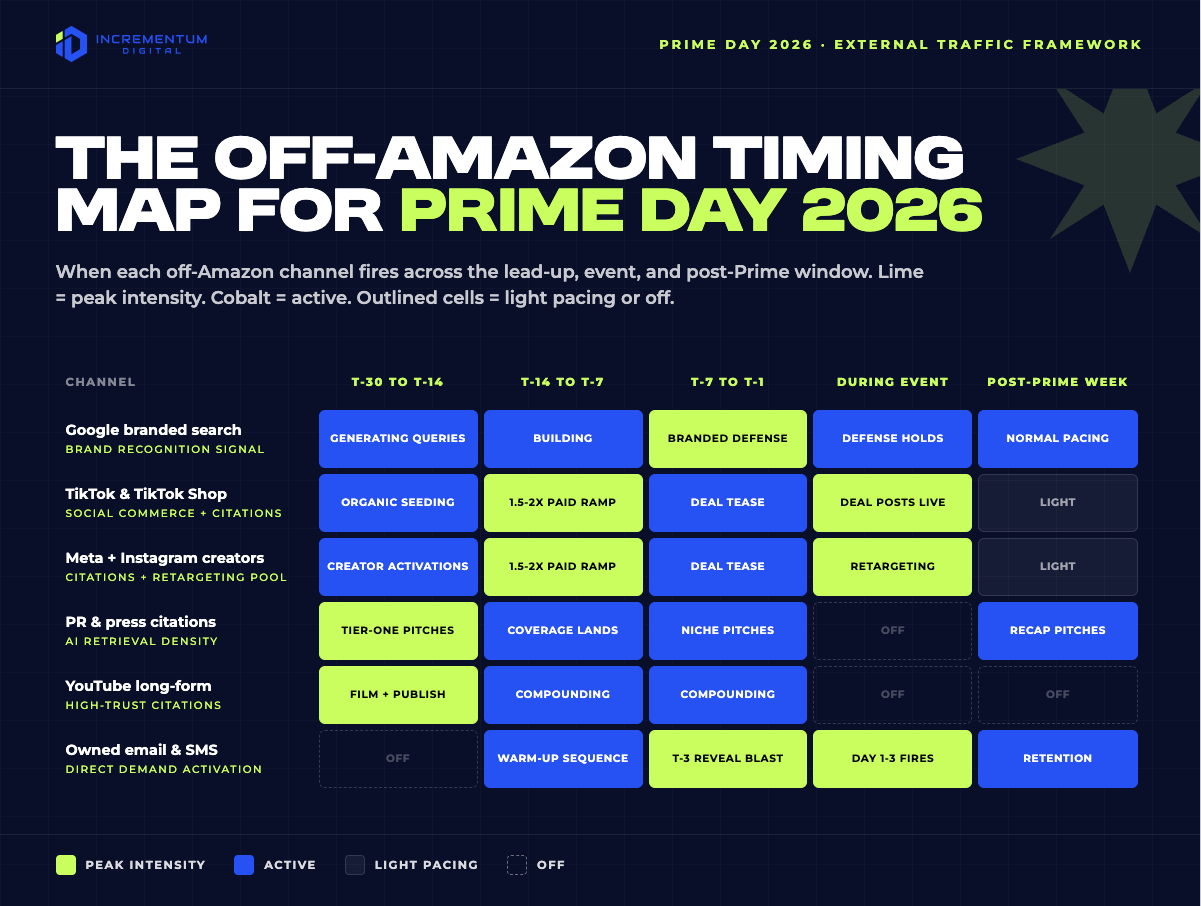
Here is the calendar we use on managed accounts at Incrementum, paired with the on-Amazon framework in our Prime Day 2026 ad stack post and the budget structure in our budget framework.
T-30 to T-14: signal generation
- PR pitches land for tier-one outlets. Press cycles take three to four weeks at minimum.
- Creator activations begin on TikTok, Instagram, and YouTube. Content needs time to compound and get indexed.
- Sponsored long-form YouTube reviews film and publish.
- Branded search velocity should be measurable in Amazon Brand Analytics and Google Trends by the end of this window.
T-14 to T-7: paid social ramp
- Meta and TikTok paid budgets ramp to roughly 1.5x to 2x normal pacing.
- Creator content distribution shifts from organic seeding to paid amplification on the strongest-performing posts.
- Retargeting audiences in Sponsored Display and DSP start filling as off-Amazon traffic lands on PDPs.
T-7 to T-1: branded search defense and owned activation
- Sponsored Brands on your branded terms goes to full pacing. Competitors will bid against your brand terms with deeper deals than normal.
- Email and SMS warm-up sequence begins. Final teaser blast lands at T-3 to T-1, announcing brand participation only (specific deal pricing stays confidential until Day 1 per Amazon’s deal program terms).
- Last-minute press pitches for niche outlets (Prime Day deal roundups, category-specific publications).
- Retargeting audiences confirmed in Sponsored Display and DSP, ready for Day 1.
During the four-day event
- Owned channels (email, SMS) fire at Day 1 deal activation, again on Day 2, and one final push on Day 3 for the warm cohort.
- Creator content shifts to deal-specific posts with shoppable links live.
- Paid social moves predominantly to retargeting against pre-Prime audiences. New-audience prospecting tends to underperform during the event itself.
Post-Prime week
- Prime Day buyer cohorts feed AMC audiences for back-to-school and Q4.
- Press follow-up: pitch performance recaps to outlets that covered the lead-up.
- Owned channels switch to retention messaging (Subscribe and Save, repeat-purchase, post-purchase content).
- Use the new Seller Central reorder dashboard, released in May, to flag SKUs where reorder rate is climbing but Subscribe and Save share is flat. Those products are the cleanest list for a Brand-Tailored Promotion or targeted S&S conversion push in the weeks after the event.
Pricing discipline in the Alexa for Shopping era
Two of the May 13 Alexa for Shopping features change the math on Prime Day pricing strategy: up to one year of price history visible to shoppers, and agentic auto-buy at target prices. Both compound the reference-pricing risk Amazon already flags in its Prime Day playbook.
The price-history view means a shopper asking Alexa for Shopping about your product can see twelve months of pricing context. A Prime Day deal that brings the price down from a six-month baseline reads as a real discount. A Prime Day deal that matches or barely undercuts a series of recent promotional periods reads as marketing. Sustained pricing in the months leading up to Prime Day is now part of the deal-credibility math.
The auto-buy feature is the structural change worth planning around. A shopper who set a target price three to six weeks before Prime Day will close automatically when Day 1 activates, regardless of whether you advertised to them that morning. Three implications:
- Day 1 captures a layer of pre-built demand that does not need Sponsored Products spend to convert. The auto-buy cohort closes on its own. Your Sponsored Products budget on Day 1 still matters for the shoppers actively searching, but the auto-buy layer is incremental on top of it.
- Pre-Prime price stability matters more. Discounting before Prime Day compresses the price history Alexa for Shopping displays. A shopper who saw the product at $24.99 for six months and then watched it drop to $19.99 the week before Prime Day will see the Day 1 deal price of $17.99 as a $2 discount, not a $7 discount. The reference-pricing risk Amazon already flags for Deals and Price Discounts now extends to the shopper-perceived discount.
- Off-Amazon price discipline compounds the on-Amazon discipline. If your product is consistently cheaper on your DTC site or on a marketplace like Walmart or Target, Alexa for Shopping can show that price comparison through Shop Direct. The on-Amazon deal becomes less compelling against a baseline shoppers can already see. The off-Amazon channels covered above need to coordinate with Amazon pricing, not contradict it.
The practical move heading into Prime Day 2026: hold reference pricing steady for at least eight to twelve weeks before the event, coordinate off-Amazon pricing to stay at or above Amazon’s reference price, and let the deal activate cleanly on Day 1. Our budget framework covers the spend-side of the same discipline.
The Best Deal versus Prime Exclusive Discount math
Amazon also confirmed the deal pricing for Prime Day 2026 in the May rollout. Best Deals and Lightning Deals run $100 upfront per promotion plus 1.5% of sales (capped at $5,000). Prime Exclusive Discount runs the same $100 plus 1.5% structure, but applies across an entire campaign rather than per parent ASIN. On a multi-SKU catalog the gap is meaningful. Thirty Best Deals costs $3,000 in upfront fees before any sale closes, while thirty Prime Exclusive products grouped into one campaign costs $100.
The hybrid catalog split Mansour walks through on the May call is to run Best Deals on hero SKUs (the placements are stronger per Amazon ad reps, and the upfront fee economics work when the volume is there) and Prime Exclusive Discount on the rest of the catalog (the variable fee only triggers if products sell, which protects the bottom line on lower-volume SKUs). The same logic applies regardless of total ad spend level, though the smaller the catalog, the less the Prime Exclusive structure matters.
What this means for new brands in established categories
The structural problem is that AI shopping surfaces reward signal density. Established brands have it. New brands launching into category-leading verticals (pet, supplements, beauty, kitchen, baby) do not. A new SKU with no review velocity, no branded search history, no creator citations, and no press coverage is invisible to Alexa for Shopping, Rufus, Google AI Overviews, and ChatGPT-style shopping queries. AI surfaces default to brands they can see, which means they default to the established ones.
The headwind is also structural and growing. eMarketer projects AI platform-driven ecommerce sales will surpass $144 billion by 2029, reaching 8.8% of total U.S. retail ecommerce. The share of purchase decisions filtered through AI shopping surfaces is going up every quarter. New brands entering established categories at any point in the next several years will face this same gravity.
Two patterns work for getting through it.
Pick a tighter category where the regular brands do not exist yet
“Pet beds” is a category where AI shopping surfaces already have established answers. “Memory-foam orthopedic beds for senior small-breed dogs” is a category where they do not. The narrower category lets a new brand become the regular brand at smaller scale, before competing head-on with the dominant players. One pet brand we have followed entered the reusable wee-wee pads market with a design-led product line that no established brand had matched. Within a year it was the third-largest seller in the niche and a seven-figure business. The market it entered was small enough that an established brand had not yet bothered to dominate it. That same brand entering “dog accessories” would not have made it.
Build the off-Amazon flywheel before the Amazon launch
The signals AI shopping surfaces ingest (branded search velocity, citation density, off-Amazon presence) all take months to build. The off-Amazon work that surfaces a brand in Alexa for Shopping today started six to twelve months ago, not the week before Prime Day. For a new brand, the implication is to start the off-Amazon work before the Amazon launch. By the time the listing goes live, your branded search should already be measurable, your category creator content should already exist, and at least one credible publication should already have covered the brand.
A new SKU with $5,000 in monthly ad spend walking into an established category against the brands AI shopping surfaces already recommend has a long climb. The work for new brands now is making yourself known off Amazon before the algorithm and the AI surfaces have to decide what to do with you.
The takeaway
External traffic to Amazon for Prime Day 2026 is now two things at once. It is still a session driver. Sessions to your PDP from Google, social, and email close at the same conversion rates they always did. It is also a brand-signal builder. The citation density, branded search velocity, and off-Amazon presence each channel produces feed the signals Alexa for Shopping and other AI surfaces use to decide which brands to recommend in a conversational query.
The practical answer for Prime Day 2026 is doing both at once. Drive session value to deal ASINs through paid social, email, and creator content. Build the brand-recognition signal AI surfaces ingest through PR, YouTube reviews, branded search generation, and consistent off-Amazon presence. The two streams compound. The mix that fits any specific account depends on category, audience, and current spend level. The principle does not.
For the full breakdown of every May Amazon update covered here, including the Sponsored Prompts data pull, the Best Deal versus Prime Exclusive Discount fee math, the Alexa for Shopping rollout, and the new Seller Central dashboards, watch the 40-minute monthly breakdown with Liran and Mansour on YouTube.
Get a free Amazon ad audit before Prime Day 2026
If you are trying to figure out which off-Amazon channels are actually moving the needle for your Amazon listings, or whether your on-Amazon ad stack is ready to absorb the traffic when it lands, our team will walk your account, map the channels worth investing in for your category and spend level, and flag the structural issues to fix first.
Request your free Amazon ad audit →
Incrementum also offers ads-only Amazon PPC management.
LET’S DISCOVER WHAT’S POSSIBLE FOR YOUR BRAND
We’re here to listen and uncover opportunities tailored to your unique goals.
Fill out the form to get started, and you’ll walk away with real insights and actionable recommendations—whether we work together or not.
- HANDS-ON LEADERSHIP
- AWARD-WINNING PARTNERSHIPS
- CUSTOM-BUILT SOLUTIONS