Amazon Advertising
How Much to Spend on Amazon Advertising for Amazon Prime Day 2026

Every April, we get some version of the same question from brand owners asking how much to spend on Amazon advertising for Amazon Prime Day 2026: “What’s the right daily budget, and how do I size the total reserve?” But we don’t recommend that starting point. What wins Amazon Prime Day 2026 isn’t the size of the ad budget; it’s knowing where every dollar needs to land, and when. We’ve seen the same pattern play out on account after account through the last two Prime Day events: the Amazon advertising daily budget that looked fine on paper runs out on Day 1, the deal push keeps firing into Days 3 and 4 when shoppers have moved on, and the long tail goes to whoever pivoted to retargeting.

Learn How to Make Listings That Convert in 2025!
Read our step-by-step guide on how to optimize your listings using Rufus AI insights. Sign up for our newsletter and get your copy for free!
Show me howThis guide breaks down what to actually budget for Amazon Prime Day 2026 — by phase, by deal status, and as a percentage of your existing Amazon advertising daily budget rather than a flat dollar target. It’s built on Incrementum’s own Prime Day playbook, the 2025 account data we’ve published, Adobe Analytics, Amazon’s own reporting, and Numerator’s consumer tracker.
What Amazon Prime Day 2025 told us about planning for Amazon Prime Day 2026
Amazon Prime Day 2025 ran July 8-11, the first time Amazon stretched the event to four days, and the data sets the baseline for any Amazon Prime Day 2026 budget plan. According to Adobe Analytics, U.S. online spend hit $24.1 billion across the event, with category lifts as steep as +112% (appliances), +105% (office supplies), and +95% (electronics). Buy Now Pay Later accounted for $2 billion of that, up 33.3% year over year.
Amazon’s own recap called it the biggest Prime Day event ever, with independent sellers (most of them small and medium-sized businesses) posting record sales and a record number of items sold.
Numerator’s shopper tracker put average household spend at $156.37 across the event, with 63% of Prime Day households placing two or more separate orders. The average order size landed at $53.34.
Two things jumped out in our own account data:
- Day 1 still did the heaviest lifting, even with a four-day window. One Incrementum-managed account running our Prime Day framework pulled $36,430 in ordered product sales by 9 AM on Day 1 — roughly 5x a typical full day, on the same deal ASIN budget caps we recommend below.
- Urgency faded fast. By Days 3 and 4, conversion rates dipped noticeably. Shoppers who didn’t buy Monday weren’t rushing — they were comparing. Pushing more deal spend into that window didn’t help; shifting to retargeting did.
For the full 2025 tactical recap, see our Prime Day 2025 advertising insights post and the multi-day sales event strategy guide that first laid out this framework.
A quick disclaimer: the percentages and dollar figures above are drawn from Incrementum’s own account-level observations across the four-day Amazon Prime Day 2025 event (July 8-11, 2025). Your own numbers will shift based on category, margin, deal depth, inventory position, competitive set, and brand maturity. Treat this as a planning framework rather than a guarantee — and pressure-test every number against your own trailing 30-day data before you stage the Prime Day 2026 budget.
The Amazon Prime Day 2026 ad spend framework (percent-based)
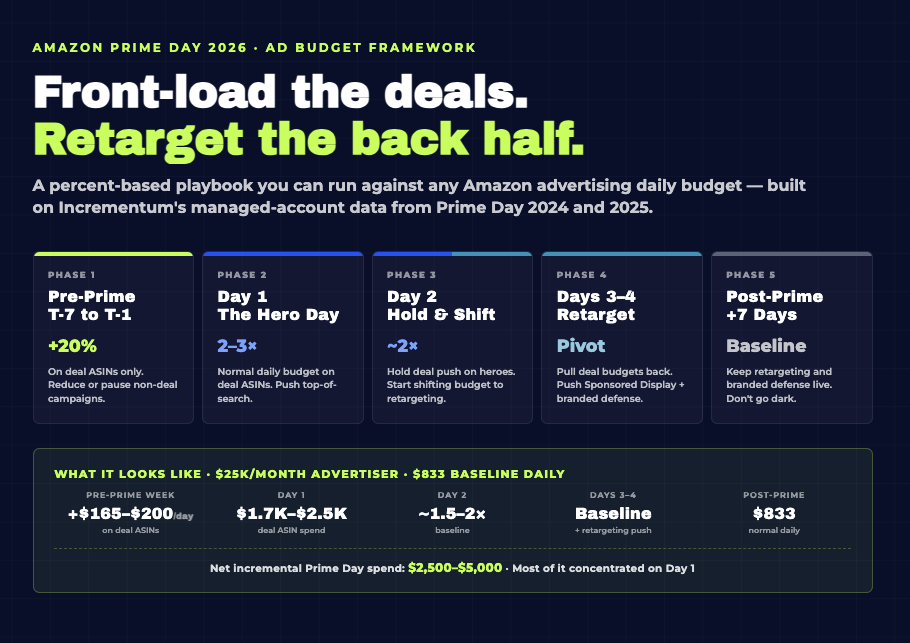
Here’s the framework we actually use on managed accounts. It’s expressed as percentages and multipliers against your existing Amazon advertising daily budget, so it scales from a $25K/month advertiser up to a seven-figure account without breaking.
The core move: front-load deal spend on Days 1 and 2, then shift to retargeting and branded defense on Days 3 and 4. Don’t keep pushing deal ASIN budgets into the back half of the event — push retargeting budgets instead.
Phase 1: Pre-Prime week (T-7 to T-1) — +20% on deal ASINs, reduce non-deal
Sessions climb before the event. Shoppers are researching, comparing, loading carts. But a cart isn’t a purchase. How you spend here depends on one thing: whether you have a deal running.
- With a deal: Push the Amazon advertising daily budget on those ASINs roughly 20% higher across the week. This catches the parked demand that will convert the moment the deal price activates on Day 1.
- Without a deal: Pull back. Reduce bids or pause non-deal campaigns unless they’re defending branded search or supporting halo sales. You’re renting traffic from shoppers who are waiting for Tuesday.
This is also the window to audit and clean up wasteful keywords. If you’re carrying any low-intent junk in your campaigns now, Prime Day will amplify it. (Our post on 5 signs your Amazon PPC is bleeding money covers the exact leaks to look for.)
Phase 2: Day 1 — 2-3x daily on deal ASINs
Day 1 did the heaviest lifting every Prime Day we’ve run, including the four-day 2025 event. The rule: cap deal ASINs at 2-3x your normal Amazon advertising daily budget, push top-of-search placement bids aggressively, and watch pacing hourly. Campaigns that are blowing through their daily budget in the first three hours need an immediate top-up.
If you’re running Sponsored Display or DSP, Day 1 is when retargeting starts paying off: carts built during the pre-Prime research week will close here.
Phase 3: Day 2 — hold the deal push, start shifting
Day 2 is the transition. Deal ASINs still deserve elevated budgets — the 2-3x multiplier can stay through Day 2 on the strongest SKUs — but this is also where you start moving spend toward Sponsored Display retargeting and Sponsored Brands halo coverage. Watch ROAS hour by hour. If conversion rates on deal ASINs are softening, that’s your signal to pull deal spend and push retargeting.
Phase 4: Days 3-4 — retargeting and branded defense take over
This is where brands make the most expensive mistake: they keep the deal spend pedal down while conversion rates and urgency have already dropped. By Day 3, shoppers who were going to buy on a deal have bought. The ones still browsing are comparing, and they’re being served by retargeting audiences, not net-new deal pushes.
- Pull deal ASIN budgets back toward normal daily levels.
- Push Sponsored Display retargeting at the audiences you built over the pre-Prime week and Day 1.
- Keep branded defense fully funded. Competitors are still bidding on your brand terms — don’t let them win cheap conversions.
Phase 5: Post-Prime (the next 7 days) — don’t go dark
Amazon’s last-click attribution means many Prime-week carts close the following week. Branded defense and retargeting should stay fully funded through the post-event window at roughly your normal Amazon advertising daily budget. If you ran Sponsored Display during the event, this is when the view-through conversions come home.
What this looks like for a $25K/month advertiser
For an advertiser spending around $25,000/month in ads — a baseline Amazon advertising daily budget of about $833 — the framework translates to something like this:
- Pre-Prime week (T-7 to T-1): +20% on deal ASIN budgets ≈ $165-$200/day extra on deal ASINs, offset by pulling bids/pausing non-deal campaigns. Rough net incremental spend across the 7 days: $700-$1,200.
- Day 1: 2-3x daily on deal ASINs = $1,700-$2,500 in deal ASIN spend, vs. your $833 baseline. This is where the biggest single-day lift sits.
- Day 2: Hold the deal multiplier on hero SKUs, start shifting non-deal budget into Sponsored Display retargeting. Total Day 2 spend typically lands at 1.5-2x baseline.
- Days 3-4: Pull deal ASIN budgets back to roughly baseline. Keep Sponsored Display retargeting elevated. Daily spend drifts back toward normal by Day 4.
- Post-Prime (7 days out): Run at normal baseline. Keep branded defense and retargeting live — don’t go dark.
Net incremental Amazon advertising spend across the 4-day event for a $25K/month account typically lands in the $2,500-$5,000 range, most of it concentrated on Day 1. That’s the number to stage in your budget planning — not a flat daily cap applied across all four days.
Accounts larger than $25K/month scale the same framework linearly. A $75K/month advertiser is looking at 3x the incremental spend ($7,500-$15,000). A $250K/month advertiser is looking at closer to 10x ($25K-$50K). The percentages and multipliers don’t change.
A note on profit vs. scale during Amazon Prime Day 2026
Whether you lean harder on deal ASIN spend (scale) or hold bids closer to normal (profit) depends on your category, margin, and deal depth. For a deeper breakdown of that tradeoff, see our profit vs. scale guide for major sales events. The framework above assumes you’re playing for scale during the event and tightening back toward profit in the post-Prime week.
How much budget is needed for Amazon advertising management services monthly?
Budget planning for Amazon Prime Day 2026 almost always raises a second question: how much budget is needed for Amazon advertising management services monthly, on top of the ad spend itself? For an advertiser in the $25K-$75K/month ad spend range — the band where most brands asking this question actually sit — Amazon PPC agency fees generally fall into one of four structures. The structure matters more than the headline dollar figure, because it decides whose interests the agency is actually optimizing for.
- Flat monthly retainer. Common at $25K-$75K/month in ad spend. Typical range is $2,500-$7,500/month, depending on catalog complexity, placement mix (Sponsored Products only vs. SP + Sponsored Brands + Sponsored Display), and whether DSP is included. Predictable for both sides but uncoupled from performance — the agency gets paid the same whether your ROAS is 2x or 6x.
- Percentage of ad spend. Typical range is 10-15% of managed spend, often with a monthly floor. Predictable per dollar of budget, but the incentive points in an awkward direction: the agency earns more when your budget goes up, not when your ad sales do. If spend doubles and ROAS halves, the agency still collects double.
- Percentage of ad sales. The model that aligns most directly with how a brand actually makes money. Industry rates vary widely — from low single digits on high-volume accounts up to 10%+ on smaller accounts or when used as a performance layer. The agency earns more only when your Amazon ad sales go up, which puts them on the same side of the table as your P&L. If you can find a partner willing to operate here at a competitive percentage, the economics almost always beat a percentage-of-ad-spend arrangement once you run the math against your own ROAS and TACOS.
- Hybrid retainer + performance. A base monthly retainer covers strategy and account management, with performance bonuses tied to TACOS improvement, revenue growth, or profit targets. Used most often on $100K+/month accounts where both sides want a floor plus upside.
The honest question isn’t which Amazon PPC management cost model looks cheapest on paper ; it’s which model puts your agency’s incentives closest to yours. A flat retainer is predictable but agnostic to your ROAS. A percentage of ad spend structure grows the agency’s revenue independent of whether your efficiency improves. A percentage of ad sales model only pays the agency more when your top line moves. Each has tradeoffs, but the alignment question is worth asking before you sign.
For Amazon Prime Day 2026 specifically, that question matters more than usual: the event creates a 96-hour window where an agency is making hourly calls about whether to keep pushing deal spend or pivot to retargeting, and fee structure quietly shapes which call gets made. Before you sign with any partner, ask how they’re compensated during event weeks, and whether that structure rewards the same outcomes you’re measuring.
A useful rule of thumb when sizing the monthly management budget against Amazon Prime Day 2026: the 96 hours of the event will consume 3-5x the management hours of a normal week. Pacing decisions need to happen hourly on Day 1, not daily. If your agency or in-house team can’t flex that much active attention into Prime Day week, the monthly fee won’t matter — the revenue you leave on the table will dwarf it.
For a full breakdown of whether the agency model pencils out versus hiring in-house, see our real-math comparison of Amazon PPC management services. The short version: the break-even depends less on fees and more on whether your in-house team can give Amazon Prime Day 2026 the 96 hours of active attention it needs.
Five Amazon Prime Day 2026 planning moves to make right now
- Audit your campaign structure. Any mess you’re carrying today compounds under Amazon Prime Day 2026 traffic. Our campaign structure guide walks through the cleanup sequence.
- Build your deal ASIN list. Which SKUs are on deal, which aren’t, and what’s the expected discount depth on each? This is the single input that determines how much to spend on Amazon advertising in your pre-Prime window.
- Stage your budget by phase, not by campaign. Write out the percent-based framework against your actual Amazon advertising daily budget — +20% pre-Prime, 2-3x Day 1, hold on Day 2, retarget on Days 3-4 — before you set a single campaign cap.
- Lock in your retargeting stack. Sponsored Display and DSP audiences need days to warm up. If they’re not built by late June, Day 1 of Amazon Prime Day 2026 will feel colder than it should.
- Set a review cadence. Every 2 hours on Day 1, every 4 hours on Days 2-4, and daily for the week after. If no one owns that cadence, the plan doesn’t matter.
The bottom line on Amazon Prime Day 2026
Prime Day isn’t getting shorter. In 2024 it was two days. In 2025 it was four. Whatever Amazon does for Amazon Prime Day 2026, the brands that treat it as a 96-hour operation — planned, staged, and actively managed — will come out with ROAS intact. The ones who ask “how much to spend on Amazon advertising?” and stop at a single Amazon advertising daily budget cap will end up funding their competitors’ Day 2.
Plan the spend. Stage the spend. Protect the spend.
Get a free Amazon ad audit before Amazon Prime Day 2026
If you want a second set of eyes on your Amazon Prime Day 2026 budget plan — or you’re not sure whether your current Amazon advertising daily budget is set up to capitalize on the four-day window — our team will walk your account for free and flag the leaks before they get expensive.



LET’S DISCOVER WHAT’S POSSIBLE FOR YOUR BRAND
We’re here to listen and uncover opportunities tailored to your unique goals.
Fill out the form to get started, and you’ll walk away with real insights and actionable recommendations—whether we work together or not.
- HANDS-ON LEADERSHIP
- AWARD-WINNING PARTNERSHIPS
- CUSTOM-BUILT SOLUTIONS