Amazon DSP
Amazon DSP for Mid-Market Brands: When It Makes Sense (and When It Doesn’t)
Amazon DSP is Amazon’s demand-side platform: it programmatically buys display, video, audio and streaming TV placements on and off Amazon using Amazon’s first-party shopping signals. For a mid-market brand, Amazon DSP makes sense once the brand is consistently profitable on Sponsored ads and wants to retarget and defend share. Not before that foundation exists.
Learn How to Make Listings That Convert in 2025!
Read our step-by-step guide on how to optimize your listings using Rufus AI insights. Sign up for our newsletter and get your copy for free!
Show me howAmazon DSP for mid-market brands is a sequencing question more than a budget question. A brand doing $5M to $50M on Amazon can almost always find the money. What decides the outcome is whether the three conditions below are already true, because Amazon DSP amplifies an advertising operation rather than repairing one.
Key takeaways
- Amazon DSP buys audiences, not keywords. Sponsored Products reaches shoppers who typed a query; Amazon DSP reaches people who have not searched for the brand yet.
- A brand with unspent headroom in Sponsored Products is buying its cheapest incremental volume there. Amazon’s search term impression share report shows what share of impressions a brand wins on each search term, which is where that headroom becomes visible.
- Amazon DSP economics turn on audience size. Retargeting pools are built from detail page views and purchases, so a brand with thin detail-page traffic has thin pools to buy against.
- Amazon’s managed-service option for DSP typically requires a minimum spend of $50,000, while self-service display campaigns carry no minimum campaign spend requirement and no management fees. The gating constraint for most mid-market brands is the management cost and the measurement patience, not the platform door.
- The useful question is never “should we run Amazon DSP.” It is “what job are we hiring Amazon DSP to do, and is that job currently unfilled.”
Why the sequence matters
- Sponsored ads have a ceiling. Past a certain point a brand pays progressively more to reach buyers it was already reaching.
- Competitors running Amazon DSP can retarget shoppers who viewed a brand’s detail pages. Amazon DSP’s advertiser audiences are driven by custom inputs like product relevance and remarketing, so those visitors are addressable to other advertisers whether or not the brand is buying them back.
- Adding Amazon DSP too early spends budget that Sponsored campaigns would have converted more cheaply, and the loss stays invisible because the two channels are measured over different horizons.
- Getting the sequence wrong produces a wrong conclusion. A brand that tries Amazon DSP before the foundation exists concludes “Amazon DSP doesn’t work for us,” and that conclusion keeps the brand out of the channel for another year.
The Three Gates Before DSP
The Three Gates Before DSP is the sequence Incrementum uses to decide whether a brand is ready for the channel: Saturation, Audience Size, Patience. The gates run in order, and a brand does not pass the second before the first.
- Gate 1 — Saturation. Has the brand run out of cheap incremental volume in Sponsored Products and Sponsored Brands?
- Gate 2 — Audience Size. Does the brand have enough detail-page traffic to build retargeting pools worth buying against?
- Gate 3 — Patience. Can the brand’s margin, inventory and reporting cadence survive a channel that pays back more slowly and is measured differently?
Each gate asks a question about the business rather than about the channel. The default Amazon DSP conversation starts with the tool, which is the wrong end of the problem: define the job first, then choose what fills it.
Gate 1: Have you saturated Sponsored ads?
Saturation means a brand can no longer buy meaningful additional volume in Sponsored Products at an acceptable cost. The signals are rising CPCs on the same converting terms, high impression share on the money keywords, and budget caps that no longer bind.
Amazon’s search term impression share report gives a brand the account-wide picture. If a brand holds a 20% impression share on a search term, it won 20% of all Sponsored Products impressions for that term. A brand sitting at 20% on its best terms has not saturated anything, and the cheapest growth available is still in search.
Budget caps deserve a separate look, because Sponsored Products daily budgets are not paced throughout the day. A campaign with a small daily budget can spend it in minutes when shopper demand is high, which means a brand can be capped for most of the day without the ACoS ever looking wrong.
Liran Hirschkorn, Founder & CEO of Incrementum Digital, described an account running a 5% TACoS that looked like one of the cleanest he had seen: profitable campaigns, hitting its target consistently, and leaving roughly $250,000 a month in sales unclaimed. One core non-branded keyword on that account converted at 33%, and the campaign carrying it hit its daily budget by mid-afternoon and switched off. The same pattern ran across a dozen of the account’s most profitable campaigns, which stopped taking new customers at around 1pm to 3pm every day. Moving that account from 5% to 7% TACoS adds roughly $3M a year in sales.
“A TACOS that’s too low is the same problem in the other direction.”
Profitable campaigns that are hitting their daily budget are the clearest signal a brand has not saturated search. Each one is demand the brand chose not to fund, and funding it costs less per incremental order than opening a display channel.
A good ACoS is not evidence of saturation. A good ACoS frequently means a brand is underspending, and the headroom it is leaving in search costs less per incremental order than anything Amazon DSP will buy. Brands working through this usually find it alongside related leaks in total advertising cost of sale, and recovering that headroom starts with disciplined keyword harvesting.
Readiness is also a per-asset judgment rather than an account-level one. A listing with a strong rating built on a handful of reviews cannot absorb scaled spend the way a slightly lower-rated listing with real review depth can, because the thin review count gives a cold shopper nothing to verify against. Budget goes to the listings that already convert a cold click. Everything else builds proof first.
Gate 2: Do you have an audience worth retargeting?
Amazon DSP audiences come in three categories, according to Amazon: Amazon Audiences built on first-party buying, browsing and streaming signals; advertiser audiences driven by custom inputs like product relevance and remarketing; and third-party audiences. For a mid-market consumer brand, the advertiser audiences are the ones that carry the early work, because they are assembled from the brand’s own detail page views and purchases.
That construction is what ties Amazon DSP economics to traffic volume. A retargeting pool is a subset of the people who already visited a brand’s detail pages, and a brand with modest detail-page traffic is buying a small pool at display prices. Amazon does not publish a minimum audience size required for a segment to be targetable, so there is no public threshold to check a brand against. The practical test is whether the pool is large enough that reaching it repeatedly changes the revenue line.
When Amazon DSP doesn’t make sense yet
Audience buying is no longer exclusive to Amazon DSP, which raises the bar for adding the channel. Mansour Norouzi, Partner and Director of Advertising at Incrementum Digital, noted that Amazon now allows up to 10 AMC audiences in a single Sponsored Products campaign, where the limit had been one audience per campaign. Testing six audiences used to mean building six campaigns carrying the same targets and budgets, so most testing stopped at two or three. A brand that wants to see how its audiences respond can now do that inside Sponsored Products at cost-per-click prices, before committing to a display budget. Advertisers outside the US marketplace are currently limited to one audience per campaign.
The second case for waiting is owned demand. A brand with a large email list or social following off Amazon has a cheaper lever available than display media, and pulling the expensive lever first buries the cheap one.
Gate 3: Can you afford to be patient?
Amazon DSP is measured over a longer horizon than Sponsored ads, so a brand needs the margin and the reporting discipline to wait. Amazon applies a 14-day attribution window to new-to-brand metrics and recommends waiting until after that period before pulling reports. A brand reading campaign ROAS on day three is reading noise.
Inventory is the second constraint. Amazon DSP creates upper-funnel demand, and demand a brand cannot fulfil is worse than no demand, because it spends budget teaching shoppers that the product is unavailable.
The third constraint is organizational. Amazon DSP rewards a monthly review cadence rather than a daily one, and the brand needs someone who will actually read that monthly report. Judging the channel on campaign-level ROAS in isolation misreads it, which is the same problem as leaning on last-touch attribution across an account.
How is Amazon DSP different from Sponsored Products and Sponsored Display?
Sponsored Products buys intent, display ads buy a narrower slice of audience with very little setup, and Amazon DSP buys audiences at scale on and off Amazon. One change matters for anyone comparing these today: Sponsored Display is now part of Amazon’s wider display ads offering, and Amazon has brought sponsored ads and Amazon DSP workflows together into a single workspace. Existing Sponsored Display campaigns continue to run, and new display campaigns are created as display.
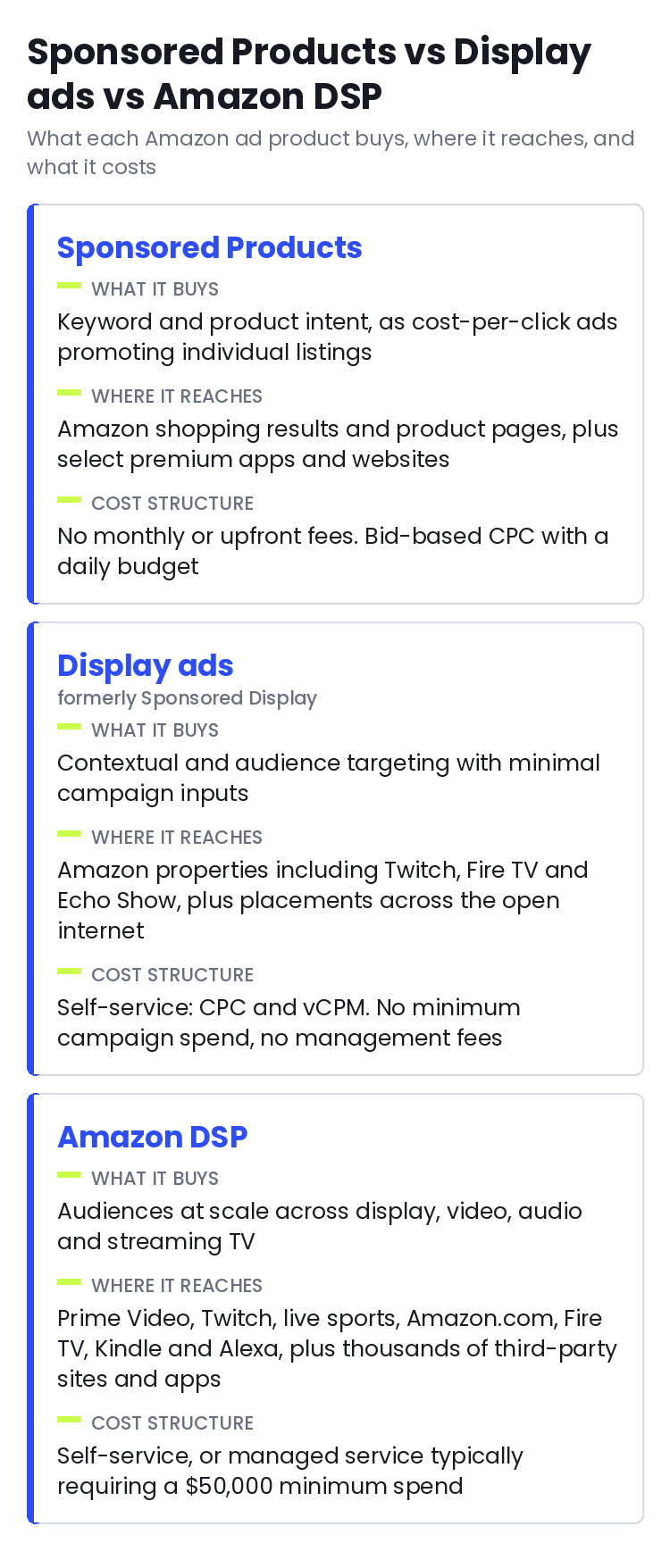
Eligibility differs too. Sponsored Products is open to professional sellers, vendors, book vendors, KDP authors and agencies. Amazon DSP is available to brand advertisers, ad agencies and tool providers, whether or not they sell products on Amazon.
What does Amazon DSP cost a mid-market brand?
Amazon DSP costs a mid-market brand across three layers: media spend, the service minimum, and management. Amazon documents the first two.
Self-service display campaigns run through sponsored ads carry no minimum campaign spend requirement and no management fees, with CPC and vCPM pricing. The managed-service option, which Amazon positions for advertisers who want consultative service or have limited programmatic experience, typically requires a minimum spend of $50,000, and Amazon notes the minimum may vary per country.
The third layer is management, and it is the one without a clean public number. Amazon does not publish agency fee structures, and no dated primary source states a reliable range, so this piece will not invent one. What a brand can do is insist the fee model is written down before launch: whether it is a percentage of media spend, a flat retainer, or a hybrid, and what happens to it when spend scales. The relevant comparison for most mid-market brands is not agency versus no agency but whether the in-house time exists, which is the same calculation behind Amazon PPC agency versus DIY.
How do you measure whether Amazon DSP is working?
Amazon DSP is measured on new-to-brand performance and total account effect rather than campaign ROAS in isolation. Amazon determines whether a purchase or detail page view is new-to-brand by reviewing the last 12 months of a customer’s purchase and browsing history; if the customer has not purchased from the brand in that window, the purchase counts as new-to-brand.
The metrics that carry the verdict are new-to-brand purchases, percent of purchases new-to-brand, cost per new-to-brand purchase, detail page views (new to brand), and branded searches (new to brand), all of which Amazon surfaces in Amazon DSP reporting alongside detail page view rate and add-to-cart counts. One detail is easy to miss and changes how a brand should set expectations: new-to-brand data is not available for Sponsored Products. It is available for Sponsored Brands and Display. A brand that has only run Sponsored Products has never seen the metric its Amazon DSP program will be judged on.
The metrics that mislead early are in-platform ROAS in month one and click-through rate on display creative. For questions that campaign reporting cannot answer on its own, such as overlap between channels or path-to-purchase, the event-level analysis sits in Amazon Marketing Cloud.
Common mistakes with Amazon DSP
- Buying Amazon DSP because a rep or an agency offered it, rather than because a defined job needed doing.
- Judging month one on campaign ROAS, inside a 14-day attribution window.
- Launching Amazon DSP while Sponsored campaigns are still hitting budget caps.
- Pointing Amazon DSP at listings that cannot yet convert a cold click.
- Running Amazon DSP without the inventory to absorb the demand it creates.
The DSP readiness checklist
Gate 1 — Saturation
- Impression share on the top 20 converting search terms
- Whether Sponsored campaigns are hitting daily budget caps
- CPC trend on the money keywords over the last 90 days
- Review count and rating on every ASIN proposed for scaled spend
Gate 2 — Audience Size
- Monthly detail page views across the catalog
- Branded search volume and its trend
- Repeat-purchase or subscription rate
- Owned demand off Amazon, including list size and social audience
Gate 3 — Patience
- Contribution margin per unit
- Inventory cover in weeks at the forecast sell-through
- The named person who reads the monthly report
- The evaluation horizon, agreed in writing before launch
How Incrementum approaches Amazon DSP
Incrementum gates Amazon DSP behind the same three questions, in the same order, before accepting the budget. The first step is sizing the Sponsored headroom and showing the brand what is still recoverable in search, because that volume is usually cheaper than anything Amazon DSP will buy. The job and the evaluation horizon go in writing before the first dollar goes out, so the review three months later measures the thing both sides agreed to measure.
Frequently asked questions
Is Amazon DSP worth it for a mid-market brand?
Amazon DSP is worth it for a mid-market brand that has saturated its Sponsored campaigns, has enough detail-page traffic to build meaningful retargeting pools, and can wait a quarter to read the result. A brand missing any of those three will usually get more from the same money in search.
What is the minimum spend for Amazon DSP?
Amazon’s managed-service option for DSP typically requires a minimum spend of $50,000, and Amazon notes the minimum may vary per country. Self-service display campaigns run through sponsored ads carry no minimum campaign spend requirement and no management fees.
Do you need an agency to run Amazon DSP?
No. Amazon offers a self-service option where advertisers control their own campaigns, and Amazon DSP is available to brand advertisers directly as well as to agencies and tool providers. The managed-service option exists for advertisers who want consultative support or have limited programmatic experience.
Can you run Amazon DSP if you don’t sell on Amazon?
Yes. Amazon states that Amazon DSP can be used by advertisers who do not sell on Amazon, and that it is available to both advertisers who sell products on Amazon and those who do not. Ads can run on Amazon-owned properties such as Prime Video, IMDb and Twitch, and across third-party publishers.
How is Amazon DSP different from Sponsored Display?
Sponsored Display is now part of Amazon’s wider display ads offering, and Amazon has unified sponsored ads and Amazon DSP workflows into a single workspace. Display ads reach audiences with minimal campaign inputs and no self-service spend minimum, while Amazon DSP buys across display, video, audio and streaming TV at scale, with a managed-service tier that typically requires a $50,000 minimum.
What to do next
Work the three gates in order against your own account. If Gate 1 is still open, the next dollar belongs in search. If all three are closed, Amazon DSP has a job to do and a horizon to be judged on.
If you want an outside read on which gate you are standing at, request a free Amazon audit. It is a real review of your account, and it includes telling you if the answer is “not Amazon DSP yet.” You can also see what an Amazon PPC audit finds before you ask for one.
Incrementum Digital is a full-service Amazon agency managing advertising, operations and growth strategy for brands from seven to nine figures in annual Amazon revenue.
Incrementum also offers ads-only Amazon PPC management.
LET’S DISCOVER WHAT’S POSSIBLE FOR YOUR BRAND
We’re here to listen and uncover opportunities tailored to your unique goals.
Fill out the form to get started, and you’ll walk away with real insights and actionable recommendations—whether we work together or not.
- HANDS-ON LEADERSHIP
- AWARD-WINNING PARTNERSHIPS
- CUSTOM-BUILT SOLUTIONS