Amazon Advertising
TACoS vs ACoS: The Metric Amazon Sellers Actually Need to Track
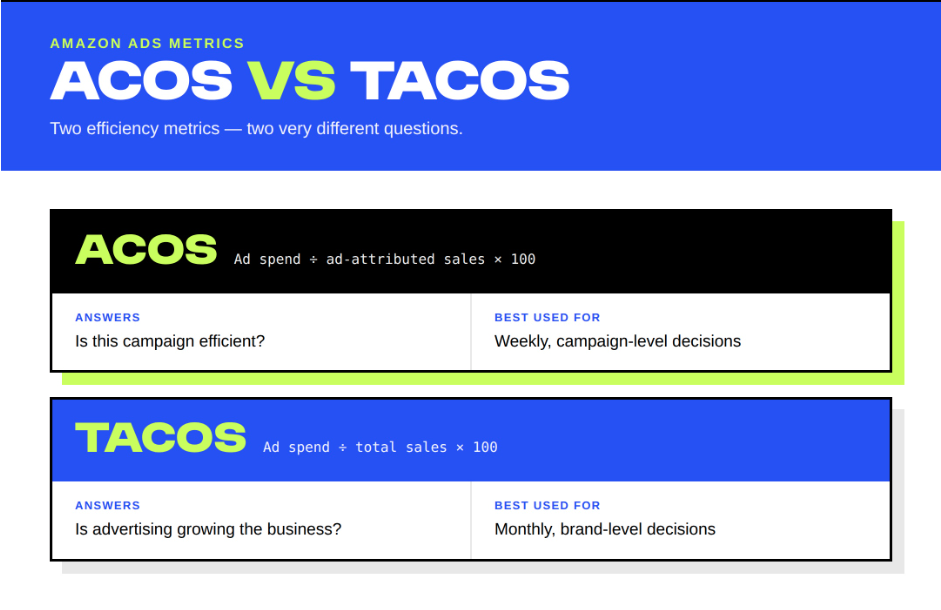
ACoS (Advertising Cost of Sale) measures ad spend against the sales an ad directly generated: a campaign-level efficiency number. TACoS (Total Advertising Cost of Sale) measures ad spend against a brand’s total sales, organic and paid combined. ACoS tells you whether a campaign is efficient. TACoS tells you whether advertising is actually growing the business.

Learn How to Make Listings That Convert in 2025!
Read our step-by-step guide on how to optimize your listings using Rufus AI insights. Sign up for our newsletter and get your copy for free!
Show me howKey takeaways
- ACoS can look excellent while a brand’s total sales stagnate, because ACoS only measures what happens inside the ad itself.
- TACoS tends to fall as a brand matures, because organic sales absorb more of the demand advertising created earlier.
- There’s no universal “good” ACoS. The right number depends on a brand’s category and margin structure.
- Optimizing for ACoS alone can starve the campaigns that build organic rank, even when those campaigns look inefficient on paper.
- ACoS and TACoS deserve different review cadences: ACoS weekly at the campaign level, TACoS monthly at the brand level, judged against a brand’s own margin structure rather than a universal benchmark.
Why this matters
- Chasing a lower ACoS without checking TACoS can shrink a business. Cutting spend to improve ACoS often reduces total sales by more than the amount saved, because the paused campaigns were feeding organic rank.
- TACoS is increasingly the number sophisticated buyers and agency-review conversations expect a brand to produce. A brand that can’t report TACoS enters that conversation at a disadvantage. That’s also why choosing the right Amazon advertising agency increasingly means asking whether a prospective partner reports TACoS at all.
- Without TACoS, a brand owner can’t tell whether a strong ACoS number reflects real growth or budget starvation of the campaigns that used to feed organic sales.
The Two-Ledger Framework
The Two-Ledger Framework is the simplest way to keep ACoS and TACoS from getting confused with each other. ACoS lives in the Efficiency Ledger: campaign-level, short-horizon, answering whether a specific dollar of ad spend converted efficiently. TACoS lives in the Growth Ledger: brand-level, long-horizon, answering whether advertising is compounding into the business overall.
Neither ledger should be read alone. A brand that only checks the Efficiency Ledger can cut spend its way to an impressive ACoS while total sales quietly decline. A brand that only checks the Growth Ledger has no way to tell which specific campaigns are wasting money. The two ledgers answer different questions, and both questions need answering every month.
What is ACoS and what does it measure?
ACoS, or Advertising Cost of Sale, is the percentage of ad spend against the sales that ad directly generated. Amazon defines the formula as ad spend divided by ad-attributed revenue, multiplied by 100. If a campaign spends $100 and generates $500 in ad-attributed sales, its ACoS is 20%.
What it measures
ACoS sits entirely in the Efficiency Ledger. It’s calculated at the campaign, ad group, or keyword level, and it only counts sales Amazon attributes to that specific ad.
What it can’t tell you
ACoS has no visibility into organic sales, the halo effect an ad creates on future purchases, or whether the brand as a whole is growing. A campaign can post a strong ACoS while contributing nothing to the brand’s overall trajectory.
What is TACoS and how do you calculate it?
TACoS, or Total Advertising Cost of Sale, measures ad spend against a brand’s total sales, organic and paid combined. Amazon has no dedicated TACoS report inside Seller Central, so brands calculate it themselves: total ad spend divided by total sales, multiplied by 100.
What it measures
TACoS sits in the Growth Ledger. The spend figure comes from the advertising console; the total sales figure comes from Amazon’s Business Reports. Divide one by the other and the result shows how much of total revenue advertising is currently costing.
What it can’t tell you
TACoS alone doesn’t identify which specific campaign is efficient or wasteful. It’s a brand-level number, not a campaign-level diagnostic. That’s still ACoS’s job. Once a brand is tracking TACoS, the natural next question is how to bring it down, which is the tactical follow-through covered in our guide to lowering TACoS and boosting profitability.
TACoS vs ACoS: what’s the real difference?
ACoS and TACoS share the same numerator, ad spend, but divide it by a different number. ACoS divides by ad-attributed sales; TACoS divides by total sales. That single difference determines whether the metric can see the whole business or only the ad campaign.
Is a low ACoS always good for an Amazon brand?
No. A low ACoS shows a campaign converted efficiently, but it says nothing about what happened to a brand’s total sales while that campaign ran.
The trap shows up most often when a brand or its agency pulls back on top-of-funnel or discovery campaigns to bring ACoS down. Those campaigns often look inefficient because they’re introducing new buyers who haven’t converted yet, rather than closing sales from shoppers who already searched by brand name. Cutting them can lower ACoS while total sales fall by more than the spend it saved, because the campaigns doing the cutting were the ones feeding organic rank. Part of the reason ACoS can mislead this way is baked into how the number is built: it comes entirely from attribution, and last-touch attribution tends to overstate how much credit a single ad deserves for a sale that may have happened anyway.
Does TACoS account for organic sales, and why does that matter?
Yes. That’s the entire mechanism TACoS is built on: it divides ad spend by total sales, so any sale that came in organically factors into the denominator whether or not an ad touched it directly.
That matters because ad-attributed numbers like ACoS can overstate how much an ad actually caused. Amazon’s own research on ad attribution found that models relying only on observational, last-touch data can substantially overstate an ad’s true causal impact on a sale. TACoS sidesteps that problem by not relying on attribution at all. It only asks whether total sales grew relative to total spend, regardless of which specific touchpoint gets the credit.
What is a good TACoS for a consumer brand?
There’s no universal good TACoS. The right number depends on a brand’s category margin and how mature the product is: a launch-stage ASIN can run a much higher TACoS than a five-year bestseller and still be healthy.
A useful way to set a brand-specific ceiling is by growth stage. A newly launched product typically runs a higher TACoS while it’s still building initial reviews and rank, and that number should trend downward over its first several months. A growth-stage product runs a moderate TACoS that should keep declining as organic sales pick up more of the load. A mature, established bestseller should run the lowest TACoS of the three, with organic sales carrying most of its total volume. The specific percentages differ by category margin, so the target should come from a brand’s own numbers, not a published benchmark.
How does TACoS behave differently during a sale event like Prime Day?
TACoS often looks unusually strong during a deep-discount event like Prime Day, because the discount itself pulls in organic and deal-driven sales that have nothing to do with any specific ad.
A brand that reads a Prime Day TACoS dip as a permanent efficiency win is measuring the wrong thing. The event inflates total sales temporarily, and once the deal ends, TACoS typically reverts toward its pre-event level. Judging TACoS against a rolling multi-month average, rather than a single promotional week, keeps a sale event from distorting a brand’s read on its actual advertising efficiency.
When should a brand prioritize ACoS over TACoS, or the reverse?
A newly launched product should prioritize ACoS, because the immediate question is whether individual campaigns can convert efficiently enough to justify scaling spend. A mature catalog should prioritize TACoS, because the real question by then is whether the whole advertising budget is still compounding into growth rather than just maintaining it.
That distinction is also where the make-or-buy question tends to surface. The real math on managing Amazon PPC in-house versus with an agency usually comes down to which ledger a brand is actually trying to optimize, and whether the team managing it has the bandwidth to watch both.
Common mistakes
- Reporting ACoS as the only KPI, without ever checking TACoS at the brand level.
- Cutting ad spend to lower ACoS without checking whether total sales dropped by more than the spend saved.
- Comparing ACoS across categories, or against a competitor’s public numbers, without accounting for margin differences.
- Judging TACoS from a single promotional week instead of a rolling average.
- Never revisiting a TACoS target as a brand matures from launch to scale.
Monthly Metrics Checklist for Brand Owners
Campaign-level (weekly):
- ACoS by campaign
- ACoS by keyword or target
- Spend pacing against budget
Brand-level (monthly):
- TACoS trend, three-month rolling average
- Organic sales as a percentage of total sales
- TACoS against the brand’s own margin-based ceiling
Decision triggers:
- When to cut spend
- When to hold spend despite a rising ACoS
- When to escalate to an agency review
How Incrementum approaches this
Incrementum builds account reporting around TACoS as the north-star number, not ACoS, because TACoS is what actually ties ad spend to business growth. What an Amazon PPC audit actually finds shows this in practice: reviewing an account by TACoS trend first, then ACoS by campaign second, tends to surface budget that’s defending an already-strong ACoS number instead of growing the business. That order of operations, brand-level number first, is the difference between an audit that confirms what a dashboard already shows and one that finds something worth changing.
Frequently asked questions
What is TACoS in Amazon advertising?
TACoS (Total Advertising Cost of Sale) measures ad spend against a brand’s total sales, organic and paid combined. It’s calculated as total ad spend divided by total sales, multiplied by 100. Because it accounts for organic sales, TACoS shows whether advertising is contributing to the business overall, not just to the campaigns it’s directly attached to.
What is ACoS and how is it calculated?
ACoS (Advertising Cost of Sale) measures ad spend against the sales an ad directly generated. Amazon calculates it as ad spend divided by ad-attributed revenue, multiplied by 100. It reflects the efficiency of a specific campaign, not the health of the business as a whole.
Should Amazon sellers track ACoS or TACoS?
Both, for different jobs. ACoS is the right lens for weekly, campaign-level decisions, such as which keywords or targets are converting efficiently. TACoS is the right lens for monthly, brand-level decisions about whether advertising is actually growing total sales.
Why can ACoS look great while a brand’s total sales stall?
ACoS only measures what happens inside the ads it’s attached to, so a campaign can post a strong ACoS number while a brand’s total sales flatten elsewhere. That gap usually shows up when spend gets cut from campaigns that were feeding organic rank rather than converting directly.
When does a low ACoS actually hurt a brand’s growth?
A low ACoS can hurt growth when it comes from pulling back on top-of-funnel or discovery campaigns that were introducing new buyers. Total sales can drop by more than the ad spend saved, because those campaigns were building the organic demand that TACoS would have caught and ACoS could not.
What to do next
Curious whether your account is optimizing the right ledger? Get a free Amazon account review and see how your ACoS and TACoS actually compare, and where the gap between them is coming from.
Incrementum Digital manages Amazon advertising, operations, and growth strategy for brands from seven to nine figures in annual revenue, and runs full TikTok Shop management as a Certified Agency.





LET’S DISCOVER WHAT’S POSSIBLE FOR YOUR BRAND
We’re here to listen and uncover opportunities tailored to your unique goals.
Fill out the form to get started, and you’ll walk away with real insights and actionable recommendations—whether we work together or not.
- HANDS-ON LEADERSHIP
- AWARD-WINNING PARTNERSHIPS
- CUSTOM-BUILT SOLUTIONS