Amazon Advertising
Amazon Prime Day 2026: The Full Amazon Ad Stack Setup
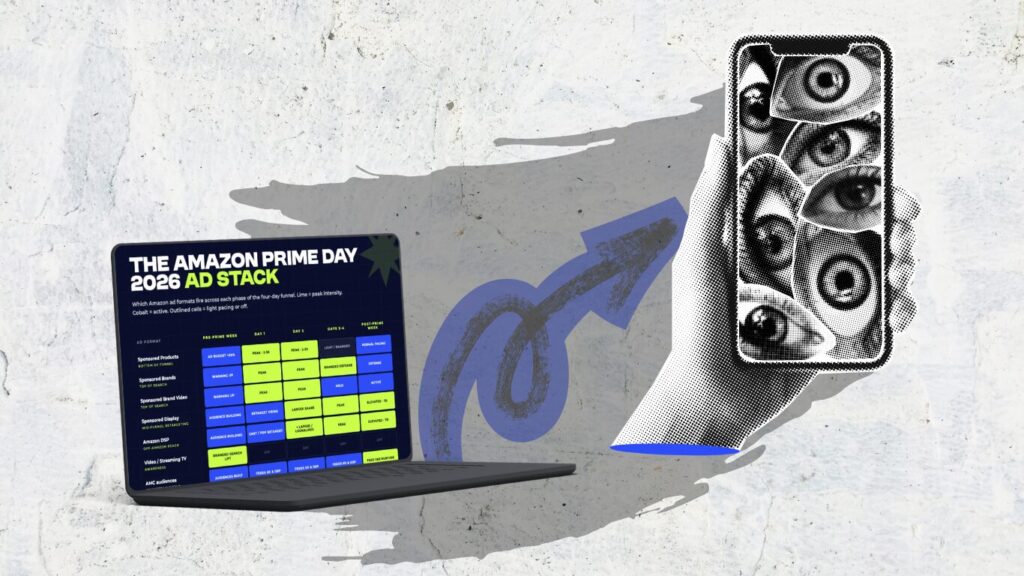
Amazon’s ad surface has expanded substantially over the last two years. Amazon’s own Q4 2025 earnings put full-year 2025 advertising services net sales at $68.6 billion, up 22% year over year, the fastest-growing segment of the business after AWS. The growth is not coming primarily from Sponsored Products. It is coming from Sponsored Brand Video, Sponsored Display, DSP, Sponsored TV through Prime Video, and Amazon Marketing Cloud audiences that connect them. Amazon has lowered the access barriers on several of these in the last 12-18 months: direct AMC access for sponsored ads advertisers (per Amazon’s own announcement), self-serve Sponsored TV, and a no-code AMC audience builder among them.
Learn How to Make Listings That Convert in 2025!
Read our step-by-step guide on how to optimize your listings using Rufus AI insights. Sign up for our newsletter and get your copy for free!
Show me howSponsored Products still sits at the bottom of the funnel, and on managed accounts at Incrementum it generally drives a large share of attributed ad sales. None of what follows changes that. But Prime Day is not a normal week of search traffic. Sessions surge, deal-aware shoppers cross-shop everything, and the conversions that close on Days 3 and 4 tend to look different from the ones that close on Day 1. The formats around Sponsored Products are where the four-day funnel actually lives.
This guide walks through each format in the Amazon ad stack, the role it tends to play inside a Prime Day funnel, and the order we usually add them on managed accounts. If you are evaluating an Amazon DSP management agency, an Amazon sponsored brands management partner, or trying to figure out whether Sponsored Brand Video and Sponsored Display are worth standing up before July, this is the map. Treat it as a framework, not a prescription; the right mix depends heavily on category, margin, and current spend level.
What Amazon ad types should I run for Prime Day?
The full ad stack available for a competitive Prime Day push is Sponsored Products, Sponsored Brands, Sponsored Brand Video (SBV), Sponsored Display, Amazon DSP, video ads (including Streaming TV through Prime Video), and Amazon Marketing Cloud (AMC) audiences layered across the rest. Each format tends to play a different role across the funnel. Sponsored Products captures intent at the bottom. Sponsored Brands and SBV defend branded search and seed top-of-search awareness. Sponsored Display retargets PDP viewers and cart abandoners. DSP extends reach off-Amazon and pulls warm audiences back, though it is not the right priority for every category. AMC can stitch the layers together with custom audiences that feed bid boosts and retargeting on other formats.
You do not need every format on Day 1, and an account without the foundation in place is usually better off skipping the bolt-on this close to the event. The honest sequencing is at the bottom of this post.
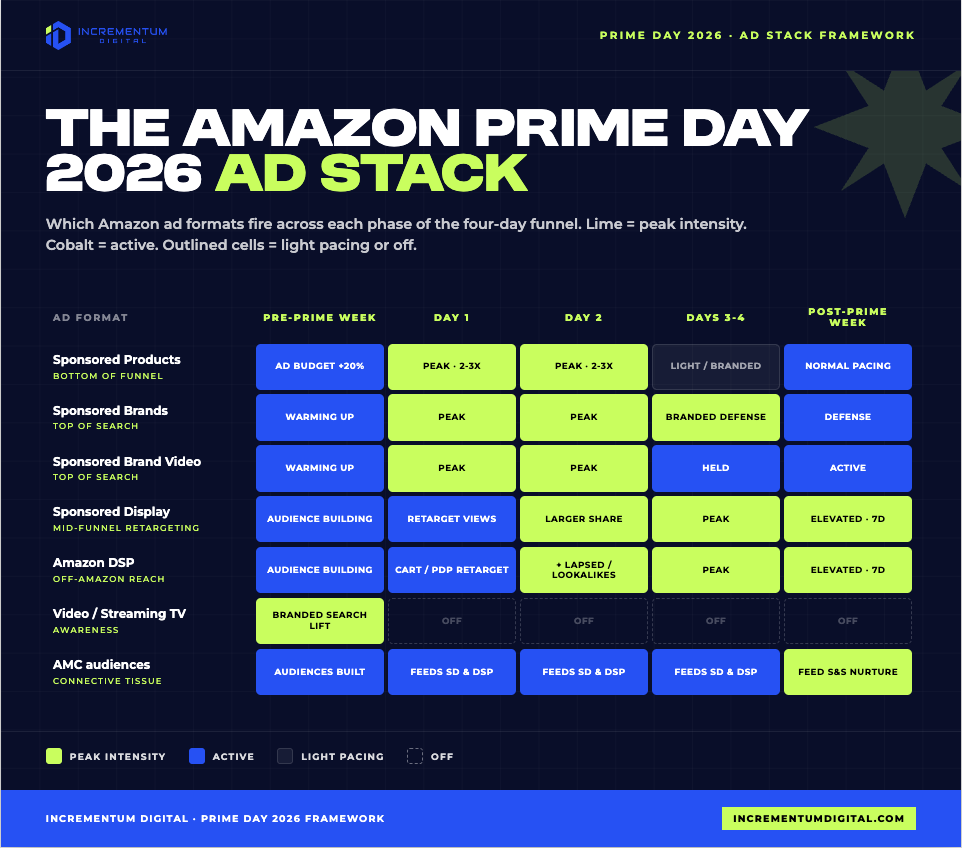
How the Amazon ad stack tends to fire across each phase of the four-day Prime Day funnel. This is the general framework we refer to on managed accounts, not a universal prescription. Pacing varies by category, margin, and current spend level.
The role each ad type plays in a Prime Day funnel
Before we go deeper into each one, here is the short version of how the formats tend to line up against shopper behavior during a four-day event.
| Ad type | Funnel role | Primary Prime Day job |
|---|---|---|
| Sponsored Products | Bottom of funnel | Capture high-intent search traffic on deal ASINs and competitor terms. |
| Sponsored Brands | Top of search, branded defense | Hold the top of search results for category and branded queries. |
| Sponsored Brand Video | Top-of-search awareness | Differentiate on category terms with motion creative. |
| Sponsored Display | Mid-funnel retargeting | Re-engage PDP viewers and cart abandoners on and off Amazon. |
| Amazon DSP | Top and mid-funnel reach (category-dependent) | Programmatic display and audience-based retargeting at scale. |
| Video / Streaming TV | Top of funnel awareness | Drive branded search and Amazon traffic in the lead-up. |
| AMC audiences | Cross-format connective tissue | Build custom audiences that feed bid boosts and retargeting on other formats. |
Sponsored Products: still the foundation, but not the whole house
If a brand could only run one ad type for Prime Day, Sponsored Products would usually be the right choice. SP placements look like organic search results, sit at the bottom of the funnel where intent is highest, and on managed accounts at Incrementum generally drive the largest share of attributed ad sales. That has not changed.
What changes during Prime Day is the math underneath. CPCs climb, search competition compresses, and an SP campaign that was holding a comfortable ACOS in May can drift materially on Day 2 of Prime Day if budget caps are not sized correctly and conversion is not protected. The fixes are structural and unglamorous: tight Auto / Exact / Broad separation for keyword discovery, separate campaigns for hero ASINs so they do not get starved by the rest of the catalog, and elevated daily budget caps on deal ASINs for Days 1 and 2 (we use a percent-based framework rather than flat dollar targets — see our multi-day sales event strategy guide for the structure and our profit vs. scale framework for the budget side).
One useful diagnostic from our audits: when more than roughly two-thirds of an account’s revenue is coming from ads, the structural problem is usually deeper than bids. Strong accounts tend to land closer to a 50-60% ad-attributed share, not 70%+. If your ad dependency is high heading into Prime Day, layering more formats on top will amplify the leak, not fix it. The five structural decisions that decide whether Amazon PPC scales covers that diagnostic in depth.
Where an SP-only strategy tends to break is at the top of the funnel and on the back half of the event. Sponsored Products is a closer, not an opener. It needs intent to already be in the system. Prime Day generates an unusual volume of new intent in the days leading up to the event and a long retargeting tail in the days after, and SP alone cannot work either side of that curve.
Sponsored Brands and Sponsored Brand Video: the top-of-search and halo layer
Sponsored Brands is the headline placement at the top of the search results page. For Prime Day, it tends to do two jobs that Sponsored Products cannot do on its own.
The first is branded defense. Competitors are usually bidding more aggressively on your branded terms during Prime Day with deeper deals than normal, and the Sponsored Brands placement is the visual anchor at the top of those results pages. If you are not running SB on your own brand terms, you are leaving that real estate available for a competitor to win at a low CPC. The second is category visibility. SB campaigns on broad category terms can hold a position above the fold on queries where Sponsored Products positions 1-3 are bid up beyond what most TACOS targets can support.
Sponsored Brand Video sits inside the SB placement but uses motion creative instead of a static logo and product image. Directionally, on category-leading brands we manage, we have seen Sponsored Brand Video CPCs come in lower than the SP equivalent on the same head terms, with stronger engagement — the placement is often the only video in a wall of static images. That pattern is not consistent across every category and depends heavily on having actual video creative worth running. But for any category where Sponsored Products clicks are getting steadily more expensive, SBV is usually worth a controlled test on a share of head-term spend before Prime Day, not after.
The practical Prime Day move: have SB and SBV running for at least several weeks before the event, not days. SB campaigns generally need conversion history before the algorithm gives them efficient placement, and standing them up the week of Prime Day means paying tuition during the most expensive week of the year.
Sponsored Display: the retargeting workhorse
Sponsored Display tends to get less attention than DSP or AMC despite a much lower lift to set up. It is also the format most worth leaning on from Day 2 onward, because Days 3 and 4 of Prime Day are generally not a deal push for warm cohorts. They are a retargeting event.
SD has three audience types worth knowing: views remarketing (people who looked at your PDP but did not buy), purchases remarketing (cross-sell into existing buyers), and Amazon audiences (interest-based and in-market segments Amazon builds for you). For Prime Day, the views remarketing audience is usually the heaviest hitter. Pre-Prime week, sessions on relevant PDPs tend to spike as shoppers research and compare. Most of those sessions do not convert immediately, but they accumulate in the SD remarketing audience. When Day 1 hits and the deal price activates, those audiences are among the warmest cohorts available, and SD can put a discounted creative back in front of them across the network.
SD also serves off-Amazon. The same retargeting audience can be served on third-party sites and apps through SD, so a shopper who looked at your product on Tuesday and then went back to scrolling Instagram on Wednesday can still see it. For a Prime Day funnel, that is incremental reach Sponsored Products cannot deliver.
What it costs: less than DSP to stand up, no separate console or formal minimum spend, and it sits inside Seller Central or Vendor Central next to your existing campaigns. For any account already running Sponsored Brands, Sponsored Display is the next-easiest layer to add.
Amazon DSP: programmatic reach where the category supports it
Amazon DSP is the demand-side platform that lets you buy display, video, and audio ads across Amazon-owned properties (Amazon, IMDb, Twitch, Prime Video) and a network of third-party sites and apps. For Prime Day, DSP can do something no Sponsored format can: serve shoppers who are not currently searching.
Where DSP tends to earn its place in a Prime Day funnel is on retargeting and lookalike audiences. Retargeting against PDP viewers, cart abandoners, and lapsed customers is generally the most reliable use of DSP spend, because the audiences are warm and the creative job is just bringing them back. Lookalike audiences (Amazon builds them off your existing purchaser data) widen reach to shoppers with similar behavioral profiles, which is where the top-of-funnel scaling for Prime Day usually comes from.
One other DSP capability worth knowing about: geotargeting. Amazon offers it on DSP and not on Sponsored Products, which means seasonal or regionally relevant products (think pool gear, tailgating products, regional team merchandise) can be targeted to states or DMAs where the conversion math works. Geotargeting is a niche capability overall. For seasonal or regional products, it can change the budget math.
The honest tradeoffs: DSP is not first priority for every category. For non-consumable products with low repeat-purchase frequency, the retargeting and lookalike economics are usually harder to defend than they are on consumables or higher-LTV categories. There is a separate console, audience and creative work that does not exist for Sponsored campaigns, and the operating overhead generally requires meaningful baseline spend before the lift pays for itself. For a brand already spending well into six figures per month on Sponsored ads heading into Prime Day, DSP is often the next biggest unlock available, especially on the retargeting side. For a brand still consolidating SP structure, it is usually too early. Our overview of how Amazon Marketing Cloud feeds DSP audiences covers the layer underneath.
Video ads and Streaming TV: the top-of-funnel layer
Video on Amazon is broader than Sponsored Brand Video. The full video stack includes SBV (inside search results), Sponsored Display Video (on PDPs and across the network), DSP video (programmatic placements), and Streaming TV ads through Prime Video. The point of running video during a Prime Day window is not last-click attribution. It is generating branded search demand in the weeks before the event so that Sponsored Products and Sponsored Brands campaigns convert on warm intent rather than net-new clicks.
The clearest signal that video is doing its job is branded search volume on Amazon. If your branded search index is climbing during pre-Prime week and your Sponsored Brands campaign on your own brand terms is showing higher impression volume, the video layer is generally working. If your Sponsored Products campaigns are showing flat conversion rates while CPCs climb in the lead-up, you may be paying for cold traffic.
Streaming TV is now accessible to more brands at lower minimums than it was two years ago. Per Amazon’s own materials, Sponsored TV is positioned as self-serve through the same console as Sponsored Products. Eligibility, minimums, and rollout vary by market and account, so confirm with your rep or in the console before assuming you can spin it up the week of Prime Day. For a brand with strong creative and a category where consideration matters (beauty, supplements, home goods, anything with a story to tell), it can be worth scoping for a Prime Day awareness window even if it would not otherwise be on the roadmap.
AMC audiences: the connective tissue across formats
Amazon Marketing Cloud sits underneath the rest of the stack. At a capability level: AMC lets you build custom audiences from first-party Amazon data (PDP views, cart adds, repeat purchasers, lapsed customers, customers who viewed but did not buy) and push those audiences into Sponsored Products, Sponsored Brands, Sponsored Display, or DSP for bid boosting or retargeting.
For Prime Day specifically, the AMC plays we have leaned on most look something like this. Treat them as a starting menu, not a universal prescription; which audiences pay off depends on category, current spend, and how much PDP traffic the brand was already generating.
- Recent cart abandoners. Generally the highest-intent retargeting audience available. Often deployed against Sponsored Display and DSP across Days 1-4.
- Repeat PDP viewers who have not purchased. Can be used as a bid-boost audience inside Sponsored Products on the relevant ASINs during the deal window.
- Lookalikes of higher-LTV customers. Top-of-funnel reach play, usually deployed through DSP where the audience economics support it.
- Lapsed customers. Win-back audience deployed against Sponsored Display and DSP with deal creative.
Per Amazon’s own announcement (also covered by Marketing Dive), AMC is no longer SQL-only for sponsored ads advertisers — Amazon has opened a no-code audience-building flow with AI assistance. That has lowered the technical barrier meaningfully. The remaining bottleneck is generally knowing which audiences to build and which campaigns to deploy them on, which is the work an Amazon Marketing Cloud agency earns its fee on.
The post-Prime story is where AMC audiences earn their second job. Prime Day buyer cohorts can feed downstream work: repeat-purchase nurture campaigns, lookalike seeds for back-to-school and Q4, and Subscribe & Save retention. Amazon recently made part of that retention picture easier to see. The Reorder and Subscribe & Save Share of Total Sales view (flagged as “New” in Seller Central) now plots weekly reorder rate alongside S&S share on the same chart. The diagnostic is whether reorder rate and S&S share are converging or diverging. A brand can be running a healthy reorder rate (in the 30%+ range during peak weeks) while S&S share sits in low single digits, meaning the demand is there but customers are reordering manually instead of subscribing. That is a retention problem that used to be hard to see and is now sitting on the dashboard.
The deeper cohort and LTV question is still messier than the dashboard makes it look. Order reports surface promotion IDs for some lever types (coupons, Brand Tailored Promotions) but not others. Best Deals, Lightning Deals, and price discounts are baked into the item price and do not appear as promotions in order reports. Tying a specific Prime Day promotion type to long-run S&S retention or LTV still requires cross-referencing multiple reports manually and reconstructing pricing history. The new view tells you whether your reorder volume is converting into subscription. It does not tell you which acquisition lever produced the highest-retaining subscribers. If your agency is promising clean Amazon-native attribution from a Prime Day cohort to long-run S&S LTV, ask them to show you the reports the analysis is built on. The repeat-purchase angle is covered in more depth in our post on how AMC works and why brands use it.
How the stack tends to sequence across the four-day Prime Day funnel
The shape we have used on managed accounts is below. It is a percent-based framework rather than flat dollar targets, and it should be paired with the full structure in our multi-day sales event guide and the budget worked example in our how-much-to-spend post. None of this is universally right; it is what we have generally seen work, and individual accounts pull harder or softer on different layers based on category and margin.
Pre-Prime week (roughly T-7 to T-1)
- Video and Streaming TV running for branded search lift (where the creative and budget support it).
- Sponsored Brands and SBV warmed up on category and branded terms.
- Sponsored Products holding normal pacing on non-deal ASINs, with roughly +20% ad budget on deal ASINs in the final week (matching the framework in our budget post).
- AMC audiences built and ready to deploy: PDP viewers, cart abandoners, lookalikes, lapsed buyers.
Day 1
- Sponsored Products at 2-3x daily budget on deal ASINs, monitored hourly.
- Sponsored Brands and SBV elevated on branded and category terms.
- Sponsored Display retargeting against the views audience built during pre-Prime week.
- DSP retargeting against AMC cart-abandoner and PDP-viewer audiences (for accounts running DSP).
Day 2
- Sponsored Products holds 2-3x on deal ASINs still converting; pull back where conversion has softened.
- Sponsored Display starts taking a larger share of incremental budget.
- DSP retargeting widens to lapsed-customer and lookalike audiences.
Days 3-4
- Pull deal ASIN spend back toward normal levels.
- Push Sponsored Display and DSP retargeting hardest, both against AMC audiences and standard SD remarketing.
- Hold Sponsored Brands branded defense at full pacing.
- Sponsored Products on branded and competitor terms only on the back half.
Post-Prime week
- DSP and Sponsored Display retargeting stay elevated for roughly a week.
- AMC audiences of Prime Day buyers feed Subscribe & Save and repeat-purchase nurture work (with the measurement caveats noted above).
- Sponsored Products returns to normal pacing on non-deal ASINs.
The honest order to build the stack
Standing all of this up two months before Prime Day is not realistic, and it is not the right order anyway. Sequence matters. If listing fundamentals are not in place, layering DSP and AMC on top of a weak conversion rate generally just amplifies the leak.
The order we usually build the stack on managed accounts, with the caveat that the right starting point depends on what is already in place:
- Listing quality, sales velocity, and review count. Without these, no ad layer scales profitably. For new launches we tend to push 30-50 reviews as a minimum threshold before scaling spend hard.
- Sponsored Products structured properly. Auto / Exact / Broad separation, hero-ASIN campaign isolation, branded defense, competitor terms. Heroes generally need meaningful dedicated daily budget to build review velocity and ranking momentum — at competitive category prices, that often lands around $10K/month per hero SKU.
- Sponsored Brands and Sponsored Brand Video. Top-of-search and branded defense.
- Sponsored Display. Views remarketing, cross-sell, and Amazon audiences. Lowest lift to add, and often the highest incremental ROI from Day 2 onward.
- AMC audiences. Custom audiences feeding bid boosts and retargeting across SP, SB, SD, and DSP.
- Amazon DSP. Programmatic reach, off-Amazon retargeting, lookalikes. Most appropriate for higher-spend, higher-repeat categories.
- Video and Streaming TV. Top-of-funnel awareness driving branded search.
For accounts heading into Prime Day 2026 with eight to ten weeks of runway, a realistic ask is: clean up Sponsored Products structure, get Sponsored Brands and SBV warmed up by mid-June, and have at least one Sponsored Display retargeting campaign running by July 1. AMC and DSP sit on top of that foundation, not in place of it. Without that foundation, Prime Day is usually better treated as a stress test of the current setup than as the moment to add new layers.
The takeaway
Sponsored Products remains the bottom-of-funnel anchor on Prime Day. That is not the question. The question is whether the layers above it are doing their jobs: Sponsored Brands and SBV defending the top of the page, Sponsored Display retargeting the warm audience the deal price will close, DSP extending reach off-Amazon where the category supports it, AMC stitching the audiences together so each layer is firing at the right cohort, and video and Streaming TV generating the branded search demand the rest of the stack converts on.
You do not have to build all of it before July. But the gap between a single-format strategy and a layered one is generally where the incremental Prime Day 2026 revenue sits.
Get a free Amazon ad audit before Prime Day 2026
If you are running mostly Sponsored Products today and trying to figure out which layers to add before Prime Day, our team will walk your account, map what the right next format is for your spend level and category, and flag the structural issues that need to get fixed first.
Request your free Amazon ad audit →
Incrementum also offers ads-only Amazon PPC management.
LET’S DISCOVER WHAT’S POSSIBLE FOR YOUR BRAND
We’re here to listen and uncover opportunities tailored to your unique goals.
Fill out the form to get started, and you’ll walk away with real insights and actionable recommendations—whether we work together or not.
- HANDS-ON LEADERSHIP
- AWARD-WINNING PARTNERSHIPS
- CUSTOM-BUILT SOLUTIONS