How a Premium Home Brand Launched on Amazon Without Sacrificing Price or D2C Performance

Overview
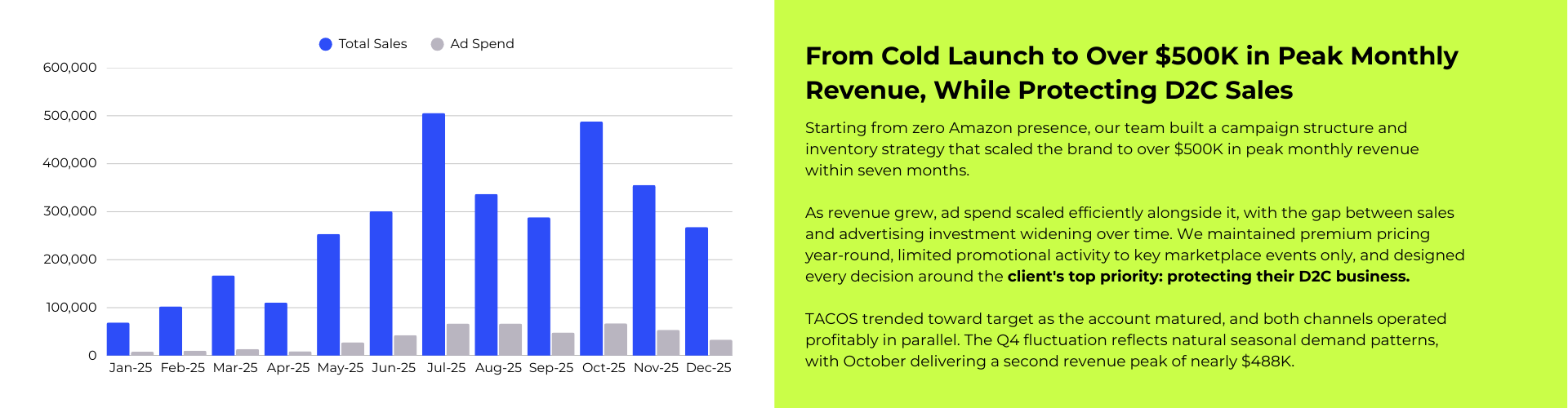
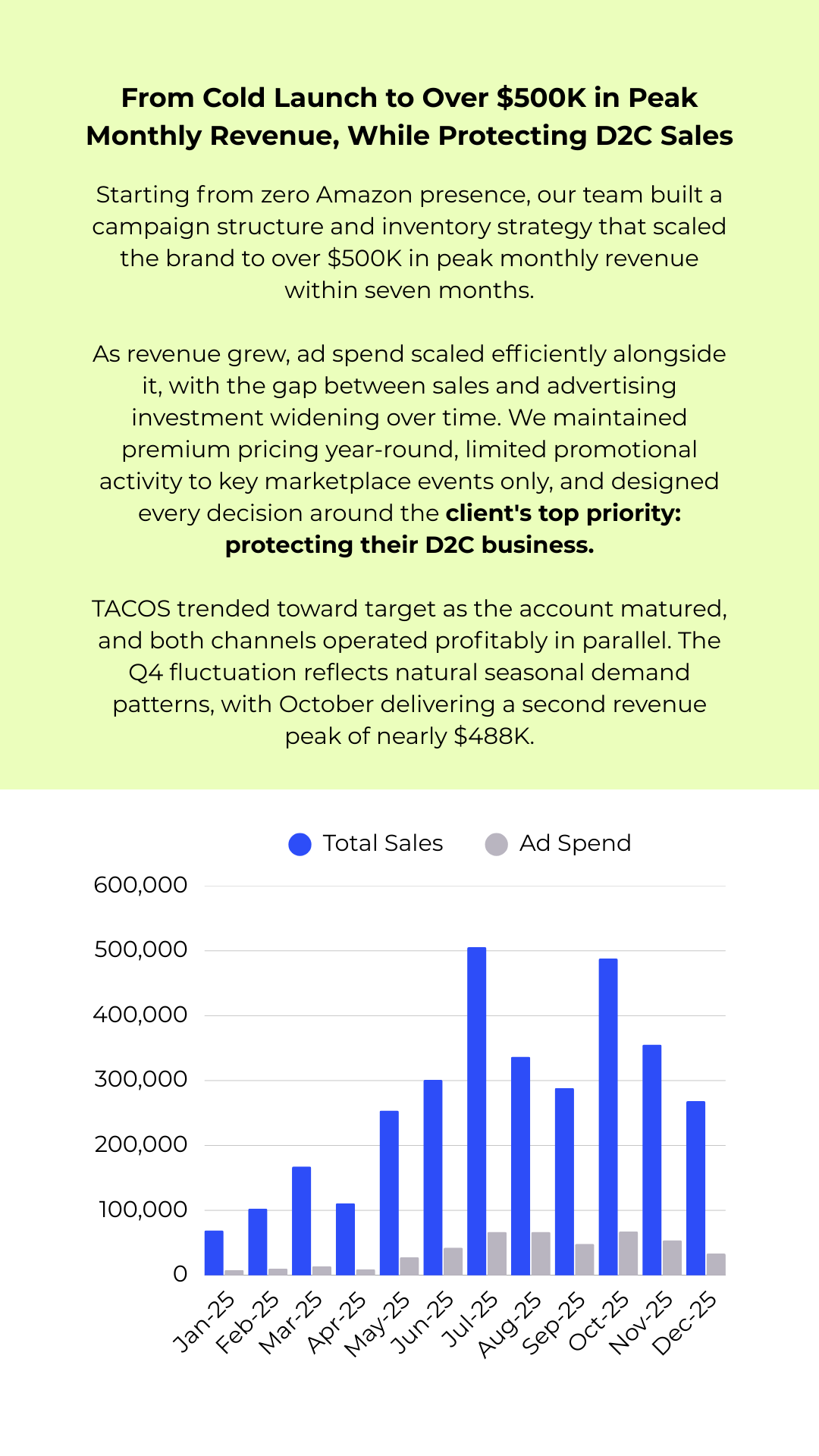
This case study follows a premium lifestyle brand with strong D2C demand and established brand recognition in the U.S. market. Their product line spanned multiple home categories at price points significantly above mass-market alternatives, but the brand had never sold on Amazon; leadership feared the marketplace would cannibalize website revenue, pressure them into discounting, and erode their premium positioning. Our team designed a channel harmony strategy that treated Amazon and D2C as complementary platforms, building a profitable marketplace presence from a complete cold start while honoring strict guardrails: no regular discounting, no inventory conflicts, and no compromise on brand positioning, ultimately delivering over $3.2 million in first-year Amazon revenue.
The Challenge
The brand came to us with clear potential but significant barriers standing between them and a successful Amazon launch:
- Significant price premium in a price-driven marketplace, competing against alternatives priced at a fraction of the cost where Amazon’s algorithm rewards lower prices and higher velocity
- Fear of D2C cannibalization, with leadership resistant to fully investing in Amazon out of concern it would erode their established website revenue
- No promotional flexibility, refusing regular discounts or coupons to protect brand positioning, eliminating one of the most common levers for early marketplace momentum
- Constrained inventory allocation, shipping only slow-moving D2C stock to Amazon rather than committing dedicated supply to the channel
- Complete cold start, launching with zero sales history, no reviews, and no organic ranking in a competitive category
More than just advertising challenges, these were strategic constraints that required a fundamentally different approach to marketplace growth.
The Approach
Channel Harmony: Protecting D2C While Building Amazon
We designed a strategy that positioned Amazon and D2C as complementary, not competing, sales channels. We advised the brand to strengthen their website's value proposition, including free shipping, so that D2C retained its own advantages alongside Amazon's fulfillment speed. On the marketplace side, we maintained premium pricing year-round, limiting promotional activity to major tentpole events only. This meant neither channel undercut the other, and customers chose based on preference rather than chasing the lowest price. The result was a dual-channel framework that gave leadership confidence Amazon wouldn't erode what they had already built.
Demand Forecasting & Inventory Decoupling
The brand's decision to ship only leftover D2C inventory to Amazon was the single biggest constraint on growth. We built a category-level demand forecast, benchmarking the brand's early trajectory against niche growth rates. The data showed the brand was outpacing the broader market, a compelling case for dedicated investment. We presented this analysis to leadership and secured agreement to allocate separate inventory specifically for Amazon, fully decoupling marketplace supply from D2C stock planning. This removed the artificial growth ceiling and allowed us to scale in line with actual demand rather than leftover availability.
Structured Keyword Capture & Efficiency-First Scaling
Given the price premium, we knew competing on broad, high-volume category terms would be inefficient. We built a campaign structure around long-tail and branded search queries where the brand's existing off-Amazon awareness gave us a natural edge. We tested keyword launches systematically across product lines, monitored search term performance weekly, and expanded into adjacent demand pockets only after profitability was validated. This approach earned top ranking positions in targeted subcategories, while TACOS improved steadily in the second half of 2025, closing the year well below the peaks seen during scaling months.
Converting Off-Amazon Awareness Into Marketplace Revenue
The brand's strongest but most underutilized asset was the consumer demand that already existed outside of Amazon. While most marketplace launches start from zero recognition, this brand had customers actively searching for them by name. We structured campaigns to capture this branded demand efficiently, funneling off-Amazon awareness into marketplace conversions. Products that had been slow movers on D2C turned out to be strong performers on Amazon, validating that the marketplace's high-purchase-intent environment was a natural fit for a premium brand that didn't need to educate shoppers, just meet them where they were ready to buy.
Our Results
$3.2 million in first-year Amazon revenue from a complete cold start
TACOS trending toward target as the account matured through 2025
Organic sales outpacing paid by year's end, proving real demand, not ad dependency
#1 rankings earned on key long-tail terms through campaign execution, not price competition
D2C sales preserved with both channels running profitably in parallel
Dedicated Amazon inventory pipeline established, replacing the initial leftover-stock approach