Amazon Advertising
Amazon PPC Agency vs. DIY: The Real Math for 7-Figure Sellers

One brand lost $170,000 in ad revenue in a single month after switching agencies. Another watched CPC surge 67% after going back to managing ads themselves. The “should I hire an Amazon PPC agency?” question is not theoretical. It is the most expensive decision you will make before Prime Day.
Learn How to Make Listings That Convert in 2025!
Read our step-by-step guide on how to optimize your listings using Rufus AI insights. Sign up for our newsletter and get your copy for free!
Show me howWhether an agency is worth it depends on your revenue, your ad spend, and how much of your time advertising is consuming. For brands doing $1M or more with monthly ad budgets above $10K, the math often favors professional management — but not always, and not for the reasons you think.
Here is the honest breakdown, written by an agency that will also tell you when you don’t need one.
The question every 7-figure brand asks before Prime Day
Amazon’s advertising business hit $68.6 billion in revenue in 2025, growing 22% year over year. It is now the third-largest digital ad platform in the world, commanding 13.9% of the U.S. digital ad market.
At the same time, Amazon now takes over 50% of sellers’ revenue in combined fees — and advertising is the fastest-growing slice of that pie. The marketplace is consolidating: new seller registrations hit a decade low in 2025, but the number of sellers generating $1M or more in revenue continues to climb.
The question for growing brands is no longer “should I advertise on Amazon?” It’s “who should manage this increasingly complex system — and at what cost?”
With Prime Day moving to late June in 2026, the window to get this right is shorter than usual.
The real cost of each option
Every “agency vs. in-house” article gives you the same vague pros-and-cons table. Here’s what they leave out: the actual numbers, the hidden costs, and the scenarios where each option makes sense.
Option 1: DIY — you manage it yourself
Direct cost: $0 in management fees.
Time investment: 5 to 10 hours per week for active campaign management. During Prime Day, double that.
Hidden costs:
- Opportunity cost. Every hour spent in Ad Console is an hour not spent on product development, sourcing, or strategic planning.
- Learning curve. Becoming competent across Sponsored Products, Sponsored Brands, Sponsored Display, and search term analysis takes months. DSP and AMC take longer.
- Mistake risk. One poorly executed campaign restructure can collapse your organic rank. We have seen it happen in 30 days (more on that below).
This makes sense if: You are doing under $500K in revenue, have a simple catalog of fewer than five SKUs, only need Sponsored Products, and have the time and interest to learn the platform deeply.
Option 2: Freelancer
Direct cost: Roughly $500 to $1,500 per month on retainer, or $20 to $45 per hour depending on experience and platform.
Hidden costs:
- Single point of failure. If your freelancer gets sick, takes vacation, or moves on, your campaigns go unmanaged.
- Limited scope. Freelancers are usually experienced with Sponsored Products. Very few have hands-on DSP, AMC, or Streaming TV experience.
- No team for peak events. Prime Day and BFCM require surge capacity. One person cannot monitor, adjust, and report across a complex account during a four-day event.
This makes sense if: You are doing $500K to $1M in revenue, need help with basic Sponsored Products management, and are comfortable with limited ad format coverage.
Option 3: Full-time in-house hire
Direct cost: A dedicated Amazon PPC specialist averages $64,000 per year according to ZipRecruiter. A more senior Amazon advertising manager averages $88,000. The Bureau of Labor Statistics puts the median for Advertising and Promotions Managers at $127,000. Factor in benefits, taxes, and equipment — the true cost of a $75K hire is closer to $95K to $105K.
Hidden costs:
- Ramp time. Recruiting takes two to four months. Training takes another two to three. That is nearly half a year before full productivity — a problem if Prime Day is around the corner.
- Scope limitations. One person realistically cannot cover Sponsored Products, Sponsored Brands, Sponsored Display, DSP, AMC, creative, and reporting at an expert level across all of them.
- Tool costs. Bid management platforms, analytics dashboards, and competitive intelligence tools run $500 to $2,000 per month on top of salary.
- Institutional knowledge risk. If that person leaves, they take years of campaign knowledge with them. This is exactly what happened in a case study we will walk through below.
This makes sense if: You are doing $10M or more in revenue and can justify a dedicated headcount, ideally supplemented by an agency or tools for DSP and AMC.
Option 4: Agency
Direct cost: Varies. Industry-wide, agencies typically charge a flat monthly fee or a percentage of ad spend — but the right fee structure should depend on your catalog size, revenue, category complexity, and growth goals. Any agency quoting you a flat rate before understanding your business is selling you a package, not a strategy.
Hidden costs:
- A bad agency can be worse than DIY. If they restructure your campaigns without understanding what was working, they can destroy years of institutional knowledge in weeks.
- Transition risk. Switching agencies — or switching from in-house to agency — carries real performance risk if not handled carefully.
- Not all agencies are full-funnel. Some only manage Sponsored Products and call it “Amazon advertising management.” If you need DSP, AMC, or Streaming TV, verify before signing.
This makes sense if: You are doing $1M to $50M or more in revenue, need multi-format expertise from day one, cannot wait six months for an in-house hire to ramp, and want a team rather than a single person managing your account during high-stakes events.
How it compares at a glance
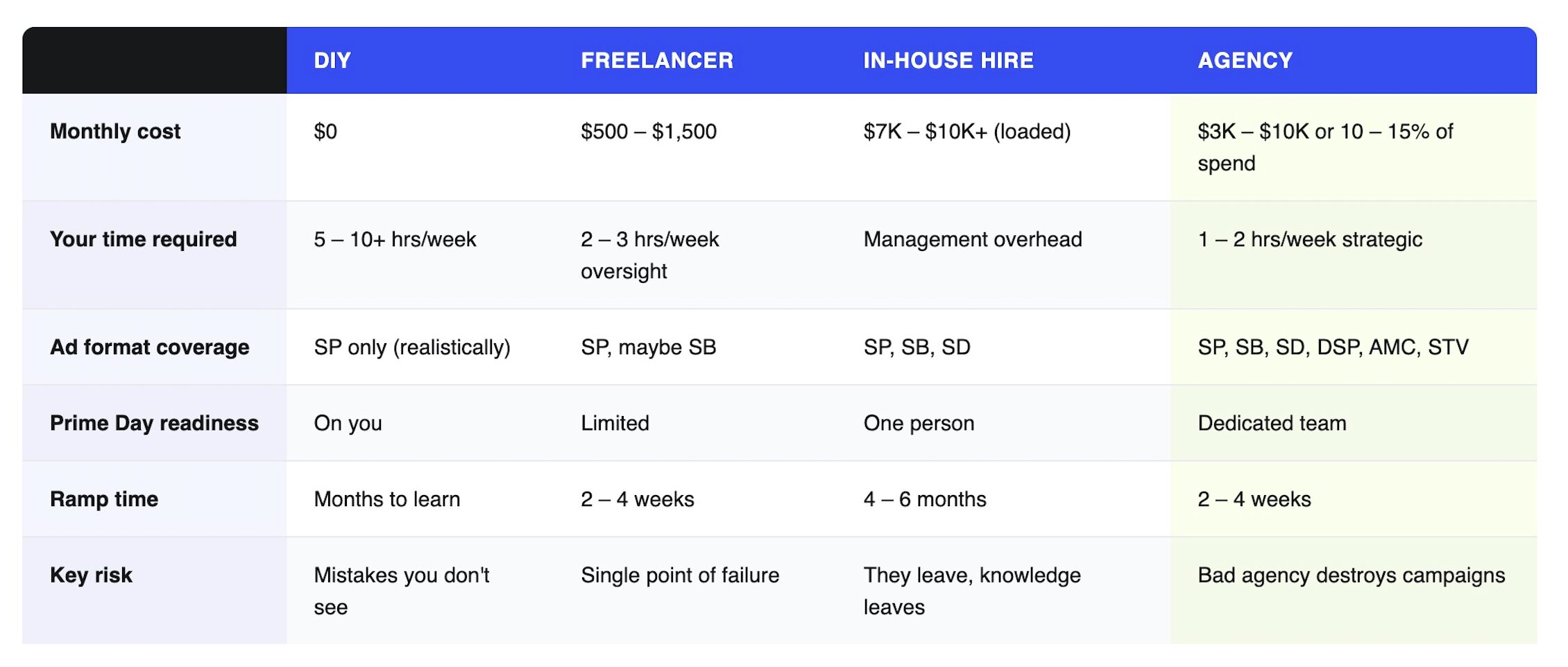
At Incrementum Digital, we scope engagement differently. Our pricing is custom, built around your catalog size, revenue, category complexity, and growth goals — because a brand doing $500K in supplements needs a fundamentally different setup than one managing 200 SKUs at $10M in home goods. We cover full-funnel advertising: SP, SB, SD, DSP, AMC, and Streaming TV, with a full team dedicated during peak events like Prime Day.
What happens when the transition goes wrong
The numbers above tell you the cost of each option. But they do not tell you the cost of getting the transition wrong — which, in our experience, is where the real damage happens.
Liran Hirschkorn, CEO of Incrementum Digital, recently shared two case studies that illustrate this.
Brand A: The slow bleed
After leaving a three-year management relationship, this brand experienced:
- CPC surged 67%, from $1.50 to $2.50
- ACOS increased substantially across the account
- Organic sales plateaued despite continued ad investment
- The brand is now reconsidering returning to professional management
No single event caused the decline. It was the slow erosion of campaign structure, bid optimization, and keyword management that had been maintained consistently for three years — then stopped.
Brand B: The 30-day collapse
A new agency took over and immediately paused the existing campaigns to “start fresh.” Here is what that decision cost:
Before the pause:
- 29% ACOS
- 3.4x ROAS
- $500K+ per month in attributed ad revenue
- 200+ active campaigns
30 days after the pause:
- Ad sales dropped 21.6% — from $797K to $625K
- ACOS doubled from 29% to 53%
- Click-through rate fell from 0.87% to 0.59%
- Organic daily units collapsed 73% — from 10,000 to 2,672
- Best Seller Rank declined across the catalog
As Liran put it: “The hardest part of Amazon advertising isn’t building performance. It’s maintaining it.”
Brand B lost roughly $170,000 in ad revenue in a single month — far more than any agency fee. And the organic rank damage took months to recover.
The takeaway is not “never switch agencies.” It is that the transition itself is a high-risk moment, and the way it is handled matters as much as the decision.
We covered how to evaluate agencies — and what red flags to watch for during onboarding — in our guide to choosing the right Amazon advertising agency in 2026.
The complexity question most comparisons ignore
When “Amazon PPC” meant running Sponsored Products campaigns with manual keyword bids, managing it yourself was genuinely viable. In 2026, that is no longer what Amazon advertising looks like.
At unBoxed 2025, Amazon announced it is unifying Ads Console and Amazon DSP into a single media buying tool. The new Performance+ feature on DSP achieved a 51% improvement in acquisition costs compared to legacy campaigns. Full-funnel campaign creation now uses AI-powered natural language setup.
The advertising formats a brand needs to consider now span Sponsored Products, Sponsored Brands, Sponsored Display, DSP display, online video, Streaming TV through Prime Video, audio ads, and custom audience targeting through Amazon Marketing Cloud.
Meanwhile, Amazon’s advertising costs keep climbing. Marketplace Pulse reports that demand for advertising on Amazon is rising faster than available inventory, driving up prices. And with ROAS holding relatively flat even as CPCs rise, brands are paying more without necessarily getting more back.
The point is not that you cannot learn all of this yourself. It is whether learning it is the highest and best use of your time — especially heading into an event like Prime Day, where the brands with clean, intentional campaign structures captured outsized returns in 2025.
How to decide: a framework, not a sales pitch
There is no universal right answer. But there are clear signals that point in one direction or the other.
You probably do not need an agency if:
- You are doing under $500K in annual revenue
- You have fewer than five SKUs in a single category
- Your monthly ad spend is under $5,000
- You have five to ten hours per week to dedicate and you enjoy the work
- You only need Sponsored Products — no DSP, AMC, or video
You probably need professional management — agency or in-house — if:
- You are doing $1M or more with 15 or more SKUs across multiple categories
- Your monthly ad spend exceeds $10,000
- You are running or need to run DSP, AMC audiences, or Streaming TV
- You have a major event approaching and your campaigns have not been audited in 90 or more days
- Your TACOS has been rising for two or more quarters while revenue stays flat
You need an agency specifically — rather than an in-house hire — if:
- You cannot wait six months for a new hire to ramp up
- You need multi-format expertise — SP, SB, SD, DSP, AMC — from day one
- Your ad spend does not yet justify a $100K-plus fully loaded salary
- You want a team with built-in redundancy for peak events, not a single person
Questions to ask before you hire anyone
Whether you are evaluating an agency, a freelancer, or an in-house candidate, these questions will help you separate the strategic partners from the ones running on autopilot.
- How will you preserve existing campaign architecture? The answer should involve an audit period before any changes are made. “We rebuild everything from scratch” is a red flag.
- Will keyword and bid history be maintained? Campaign history contains years of performance data. Deleting it is like burning your playbook.
- What does your first 30-day plan look like? You want to hear “audit, understand, then optimize” — not “restructure immediately.”
- Can we track TACOS weekly for 90 days during the transition? This keeps both sides accountable and catches problems early.
- Do you manage DSP, AMC, and Streaming TV — or just Sponsored Products? If they only manage SP, they are not offering full-funnel Amazon advertising management.
- How many accounts does each strategist manage? If the answer is 30 or more, your account is not getting strategic attention.
- What is your plan for Prime Day specifically? This is a tell. A generic answer means they do not have one.
We go deeper on this in our guide: How to Choose the Right Amazon Agency (Without Wasting 12 Months).
The bottom line
The “agency vs. DIY” question is really three questions: What is the real cost of each option? What is the cost of getting it wrong? And what is the best use of your time at your current stage?
For a brand doing $300K with three SKUs, DIY makes perfect sense. For a brand doing $5M across 50 SKUs heading into Prime Day, the math almost always favors professional management — and the stakes of a bad transition are too high to take casually.
The right answer depends on your specific situation: your revenue, your margins, your catalog complexity, your internal bandwidth, and your growth goals. Not a pricing table on a blog post.
Where to go deeper
- 5 Signs Your Amazon PPC Is Bleeding Money Before Prime Day — Diagnostic signals that something is off in your account
- 3 Hidden Leaks in Most Amazon Ad Accounts (and How to Fix Them) — Structural issues that silently drain ad budgets
- The Amazon Seller’s Guide to Lowering TACOS and Boosting Profitability — Why TACOS matters more than ACOS
- How to Strategize for Multi-Day Amazon Sales Events Like Prime Day — Campaign structure and budget allocation for peak events
- Profit vs. Scale: How to Choose Your Amazon Advertising Strategy — Framework for the growth vs. efficiency tradeoff
- How a Well-Organized Campaign Structure Sets You Up for Long-Term Success — Why campaign architecture matters
- Your Amazon Ads Are Wasting Budget Without Proper Keyword Harvesting — The keyword management process many brands skip
And if you want someone to look at your specific situation — whether you need an agency, an in-house hire, or are fine doing it yourself — request a free Amazon audit. We will review your account and give you an honest read. No commitment, no generic report — just a clear picture of where you stand heading into Prime Day.
Sources cited in this article:
2026 sources:
- PYMNTS: Amazon May Move Prime Day to Late June (Mar 2026)
- Marketplace Pulse: Amazon Seller Registrations Hit Decade Low in 2025 (Jan 2026)
2025 sources:
- CNBC: Amazon’s Ad Business Grew 19% in First Quarter (May 2025)
- eMarketer: Amazon’s Ad Surge Overshadows Everything (2025)
- eMarketer: Advertising on Amazon Is Getting More Expensive, but ROAS Is Holding Steady (2025)
- Marketplace Pulse: Amazon Takes a 50% Cut of Sellers’ Revenue (2025)
- Marketplace Pulse: Amazon Ads Are Getting More Expensive (2025)
- Amazon Ads: unBoxed 2025 Recap (Oct 2025)
- Amazon Ads: DSP Performance+ (2025)
- ZipRecruiter: Amazon PPC Specialist Salary (Dec 2025)
- ZipRecruiter: Amazon Advertising Salary (Feb 2026)
- Bureau of Labor Statistics: Advertising, Promotions, and Marketing Managers (May 2024)
- Liran Hirschkorn, LinkedIn: Agency Transition Case Studies (Mar 2026)





LET’S DISCOVER WHAT’S POSSIBLE FOR YOUR BRAND
We’re here to listen and uncover opportunities tailored to your unique goals.
Fill out the form to get started, and you’ll walk away with real insights and actionable recommendations—whether we work together or not.
- HANDS-ON LEADERSHIP
- AWARD-WINNING PARTNERSHIPS
- CUSTOM-BUILT SOLUTIONS